

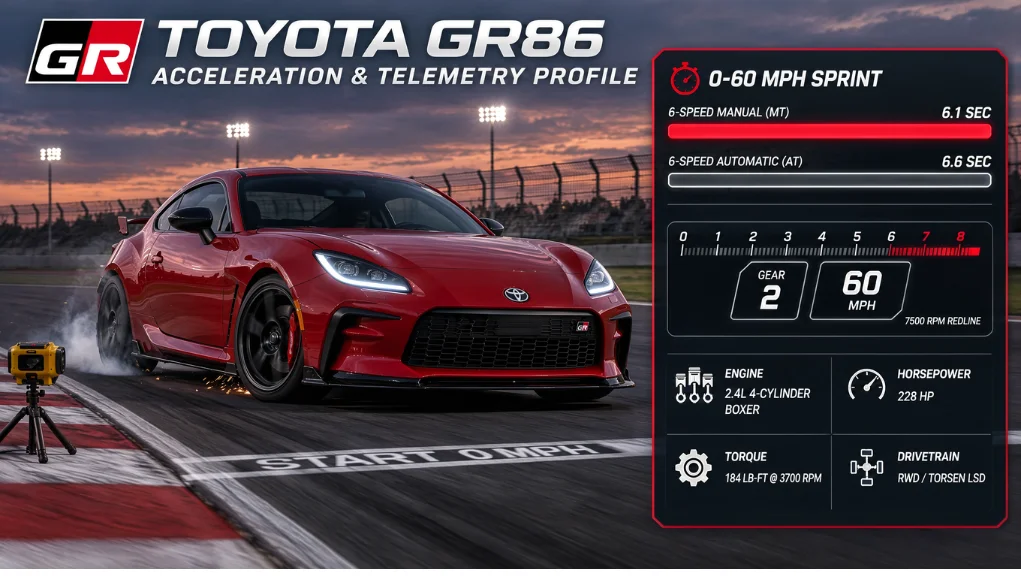
The Toyota GR86 0-60 time is officially 6.1 seconds with the six-speed manual transmission. Toyota rates the automatic version at 6.6 seconds. Independent testers have recorded quicker manual launches, including a 5.4-second run from Car and Driver.
That difference can make performance figures seem confusing at first. Manufacturer estimates and instrumented magazine tests use different conditions and testing methods. Looking at both gives you a more realistic picture of the car’s acceleration.
GR86 Acceleration at a Glance
| Version or Test | 0–60 mph | Source or Context |
|---|---|---|
| Manual, Toyota estimate | 6.1 seconds | Toyota |
| Automatic, Toyota estimate | 6.6 seconds | Toyota |
| Manual, Car and Driver test | 5.4 seconds | Instrumented test |
| Automatic, Car and Driver test | 6.1 seconds | Instrumented test |
| Manual, MotorTrend test | 5.8 seconds | Instrumented test |
| Automatic, MotorTrend test | 6.6 seconds | Instrumented test |
| Manual, Edmunds test | 6.0 seconds | Instrumented test |
| Automatic, Edmunds test | 6.9 seconds | Instrumented test |
Direct answer: A stock GR86 usually reaches 60 mph in roughly 5.4 to 6.1 seconds with the manual. Automatic versions generally need about 6.1 to 6.9 seconds. Toyota’s official estimates are 6.1 seconds for the manual and 6.6 seconds for the automatic.
Why Toyota GR86 0-60 Numbers Differ Between Tests
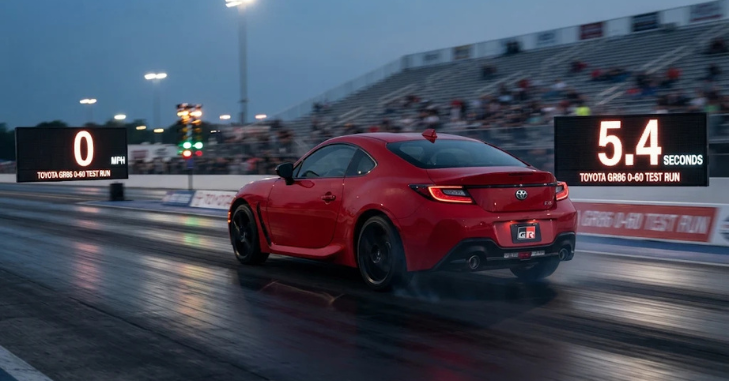
A Toyota GR86 0–60 result isn’t fixed under every condition. Tires, pavement, temperature, fuel, driver technique, and testing procedures can change the result. Even the same vehicle can produce different times on different days.
One major factor is rollout, which some publications use when measuring acceleration. Rollout starts the timer after the vehicle travels a short initial distance. Car and Driver notes that its 5.4-second manual result excludes a one-foot rollout worth 0.3 second.
Launch technique also makes a large difference with a rear-wheel-drive manual sports car. Too many engine revolutions can overwhelm the rear tires and create wheelspin. Too few can make the engine fall below its strongest acceleration range.
How Fast Is the Manual GR86?
The six-speed manual produces the strongest published acceleration results for the current generation. Car and Driver recorded 60 mph in 5.4 seconds and a 14.0-second quarter-mile. Its tested car crossed the quarter-mile at 101 mph.
MotorTrend produced a slightly slower but still impressive 5.8-second result. Its manual test car completed the quarter-mile in 14.3 seconds at 98.7 mph. That test also measured a curb weight of 2,817 pounds.
Edmunds recorded a six-second-flat run with the manual transmission. These results show why one number should not define real-world performance. A sensible expectation for a healthy stock manual is roughly the mid-five-second to six-second range.
Is the Automatic GR86 Slower?
Yes, published testing consistently shows the six-speed automatic trailing the manual in acceleration. Toyota gives the automatic an official 6.6-second estimate to 60 mph. The company lists the manual at 6.1 seconds under its stated conditions.
Car and Driver has recorded 6.1 seconds with an automatic test car. MotorTrend measured 6.6 seconds, while Edmunds reported 6.9 seconds. Different test conditions explain part of that spread.
The automatic still offers useful benefits for commuters and drivers facing frequent traffic. It includes paddle shifting while removing the workload of operating a clutch. Buyers focused purely on acceleration and driver involvement will generally prefer the manual.
What Makes the GR86 Quick Enough With Only 228 Horsepower?
Every current U.S. model uses a naturally aspirated 2.4-liter boxer four-cylinder engine. Toyota rates it at 228 horsepower and 184 pound-feet of torque. Peak torque arrives at 3,700 rpm, helping the engine pull strongly through its middle rev range.
Low weight is equally important to the car’s acceleration. Toyota has used aluminum for the hood, roof panel, and front fenders. The lightweight construction helps the modest engine deliver respectable straight-line performance.
Rear-wheel drive also gives the coupe the classic layout expected from an affordable sports car. A Torsen limited-slip rear differential comes with either transmission. That differential can improve traction while accelerating through and away from corners.
For more performance-focused automotive coverage, Newsloger’s Automobile section collects related vehicle content. Readers interested in much quicker straight-line acceleration can also see the Electric Hellcat performance guide. That Dodge comparison shows how different powertrain layouts change acceleration dramatically.
Does the 2027 GR86 Get Faster?
Toyota has updated the car for 2027, but it has not announced a higher horsepower figure. The engine still produces 228 horsepower and 184 pound-feet of torque. Toyota also continues to advertise a 6.1-second 0–60 figure.
The 2027 updates instead focus on driver response and everyday operation. Toyota revised throttle calibration and improved fifth-to-fourth downshift feel. Those changes may affect responsiveness without changing the headline acceleration specification.
That distinction matters when comparing model years. A car can feel sharper without gaining significant straight-line speed. Buyers should not assume revised calibration automatically means a quicker measured sprint.
How the GR86 Compares With Other Affordable Performance Cars
The GR86 prioritizes balance and driver feedback rather than winning every acceleration comparison. MotorTrend measured a manual car at 5.8 seconds to 60 mph. The publication says the turbocharged Mustang EcoBoost can reach 60 mph in 4.9 seconds.
That does not make the smaller Toyota unsuccessful as a sports car. Its appeal includes rear-wheel drive, a manual option, compact dimensions, and relatively low weight. Straight-line acceleration represents only one part of its performance character.
A recent Edmunds comparison also measured the Toyota at six seconds flat against the 2026 Honda Prelude. The Prelude needed 7.2 seconds in that test. Edmunds still viewed the Honda as stronger for some everyday-use priorities.
What Can Change Your Real-World 0–60 Time?
Published numbers assume controlled testing, so your own result can differ considerably. Road surface, elevation, weather, fuel load, passenger weight, and tire condition all matter. A hot day or poor surface can reduce available acceleration.
Tire temperature becomes especially important during a hard launch. Cold or worn tires can spin before effectively transferring engine output to the road. Good summer tires generally offer better warm-weather grip than all-season alternatives.
Driver technique matters more with the manual gearbox. Launching quickly requires balancing engine speed, clutch engagement, and traction without excessive wheelspin. Repeated hard launches can also increase wear on the clutch, tires, and drivetrain.
Is the GR86 Fast Enough for Daily Driving?
For most U.S. roads, the car has enough acceleration for normal merging and passing. A sub-six-second manual test result is quick by everyday standards. Drivers also get performance that remains accessible without extreme power levels.
Its character becomes clearer once the road starts turning. Reviewers consistently emphasize steering, balance, and chassis response alongside acceleration. That focus explains why enthusiasts often judge the car on more than one stopwatch figure.
The modest output can also make the performance easier to use legally. Drivers can work through more of the engine’s rev range without immediately reaching extreme speeds. That characteristic suits buyers who value involvement over effortless horsepower.
Should You Choose the Manual or Automatic?
Choose the manual if acceleration and traditional sports-car involvement are your priorities. Independent tests consistently show it reaching 60 mph sooner. The transmission also gives the driver direct control over clutch engagement and gear selection.
Choose the automatic if commuting convenience matters more than the quickest launch. It remains responsive enough for normal driving and includes paddle shifters. Its acceleration disadvantage is noticeable on paper but smaller during ordinary street use.
Your decision should consider more than a stopwatch result. Test both transmissions before buying, because control feel can matter more than several tenths. Used-car shoppers should also verify paperwork and ownership records before purchase through Newsloger’s vehicle bill-of-sale guide.
The Bottom Line
The GR86 can be noticeably quicker than Toyota’s conservative headline estimate under instrumented testing. Manual examples have recorded 5.4, 5.8, and 6.0 seconds across major U.S. publications. Toyota itself continues to quote 6.1 seconds for the manual.
Automatic models generally land in the six-second range, from about 6.1 to 6.9 seconds. They trade some straight-line speed for easier daily operation. Either version keeps the lightweight, rear-wheel-drive formula that defines the car.
If outright acceleration is your only priority, several turbocharged competitors are quicker. If handling and driver involvement also matter, the GR86 remains a distinctive choice. Compare both transmissions in person before deciding which version fits your driving.
Frequently Asked Questions
What is the Toyota GR86 0-60 time?
Toyota lists 6.1 seconds for cars equipped with the six-speed manual transmission. It lists 6.6 seconds for the automatic version. Independent manual tests have been as quick as 5.4 seconds.
What is the fastest stock GR86 0–60 time?
Car and Driver recorded a 5.4-second run with a second-generation manual model. That result used the publication’s standard testing methodology and excluded one-foot rollout. Different conditions can produce slower results with an otherwise similar car.
Why is the GR86 manual faster than the automatic?
Published tests show the manual reaching 60 mph sooner despite identical advertised engine output. Gear ratios, transmission behavior, launch technique, and testing conditions can affect measured acceleration. The manual also gives skilled drivers direct control over the launch.
How much horsepower does the GR86 have?
The current U.S. model uses a 2.4-liter naturally aspirated boxer engine. Toyota rates the engine at 228 horsepower and 184 pound-feet of torque. Those figures remain unchanged for the 2027 model year.
Is a GR86 faster than a Mustang EcoBoost?
In MotorTrend testing, the turbocharged Mustang EcoBoost reached 60 mph in 4.9 seconds. The publication recorded 5.8 seconds for the manual Toyota. The Mustang therefore has the advantage in that specific straight-line comparison.
Does the GR86 need premium gasoline?
Toyota’s recent specifications call for 93-octane fuel or higher. Using the recommended fuel helps the engine operate as intended. Owners should follow the fuel guidance in their specific model-year manual.


