

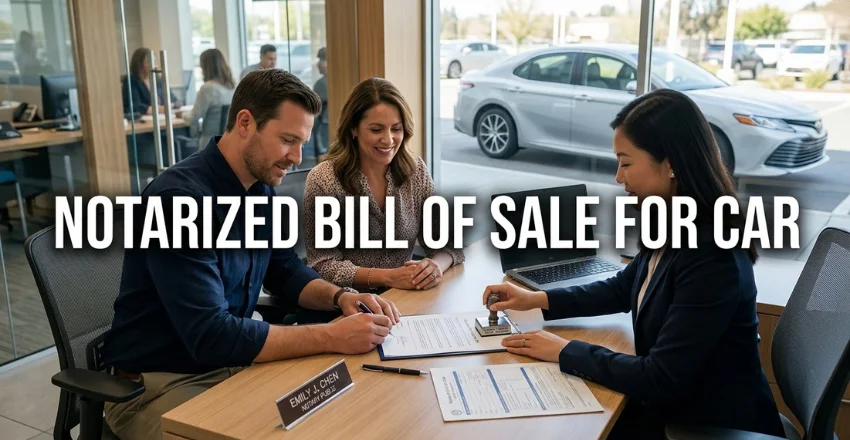
Buying or selling a vehicle privately creates paperwork that deserves careful attention. A notarized bill of sale for car transactions records key terms and confirms that the listed people signed the document. Whether notarization is required depends on the state, vehicle, and transaction.
Key Facts at a Glance
| Question | What to know |
|---|---|
| Is notarization required nationwide? | No. Requirements vary by state and transaction. |
| What does the document record? | Buyer, seller, vehicle, VIN, mileage, price, date, and terms. |
| Does it replace the title? | No. The title remains central to ownership transfer. |
| Should the title and bill of sale match? | Yes. Names, vehicle details, price, and dates should be consistent. |
| Is an odometer disclosure important? | Yes. Federal rules apply to many vehicle transfers. |
| Can rules change? | Yes. State requirements can change, as Maryland demonstrated in 2026. |
Direct answer: A notarized bill of sale for car transactions is a signed record of the vehicle sale that a notary witnesses and authenticates. It can document the price, vehicle details, mileage, buyer, seller, and sale terms. Not every U.S. state requires notarization, so check the rules of the state handling the title or registration before signing.
What Is a Notarized Bill of Sale for a Car?
A bill of sale records the agreement between a buyer and seller during a vehicle transaction. Vehicles are generally treated as personal property, and Newsloger’s guide to the chattel definition in U.S. law explains that concept. It usually identifies the vehicle, parties, purchase price, transaction date, and other agreed terms. A notary can verify the signers’ identities and witness their signatures.
The document does not automatically replace a vehicle title. The title is generally the primary ownership document used by a state motor vehicle agency. A bill of sale instead provides detailed evidence about the transaction and its terms.
This distinction matters when buying from a private seller. New York, for example, requires acceptable proof of ownership and lists a vehicle bill of sale among the documents used for certain transfers. Its DMV also specifies what an acceptable bill of sale should include.
Do You Need Notarization in Every U.S. State?
No, there is no single nationwide rule requiring every private car sale to use a notary. State motor vehicle agencies establish their own procedures, and those requirements can depend on the transaction.
California provides a clear example of a state that does not require notarization for its bill of sale. Its DMV states that a bill of sale identifying the vehicle is acceptable and does not need to be notarized or witnessed.
Maryland illustrates why you should check current rules instead of relying on older articles. Effective October 1, 2026, Maryland repealed its requirement for a notarized bill of sale for private sales involving vehicles less than seven years old.
Other states can have different requirements, including notarization for particular transactions or ownership documents. Before completing the sale, check the DMV or motor vehicle agency for the state where the transfer will be processed.
What Information Should the Document Include?
A useful bill of sale should identify the transaction with enough detail to avoid confusion later. The exact state form can require additional information, so treat a general template as a starting point rather than a universal form.
Include these details where applicable.
- Full legal names of the buyer and seller.
- Current addresses for both parties.
- Vehicle year, make, model, and body type.
- Vehicle identification number, or VIN.
- Current odometer reading.
- License plate information when required.
- Date of sale or transfer.
- Agreed purchase price.
- Payment method and payment status.
- Existing liens or lien-release information.
- Vehicle condition and warranty terms.
- “As-is” language when appropriate.
- Signatures for required parties.
- Notary acknowledgment when required.
The VIN deserves special attention because it identifies the specific vehicle involved. Compare it against the vehicle, title, and registration before signing the paperwork.
How to Complete a Notarized Car Bill of Sale

The process is straightforward when both parties prepare the information beforehand. The exact signing procedure can differ by state, so follow the instructions attached to the applicable DMV form.
1. Confirm the state requirements
Start with the DMV or motor vehicle agency responsible for the transfer. Check whether a bill of sale is required and whether your transaction requires notarization. Also verify whether the state provides an official form.
2. Gather the vehicle information
Collect the VIN, year, make, model, mileage, title information, and other required details. Compare these details with the physical vehicle and title before completing the document.
3. Record the transaction terms
Enter the agreed price, payment method, sale date, and relevant conditions. If the vehicle is sold with a warranty or specific promise, put those terms in writing.
4. Complete the odometer disclosure
Federal odometer rules require disclosures for many vehicle ownership transfers. NHTSA states that Model Year 2011 and newer vehicles generally require disclosure for the first 20 years.
Complete the odometer disclosure accurately and before the ownership transfer. NHTSA also states that an odometer disclosure can be included in a bill of sale or another transfer document, as long as it contains the required information.
5. Sign before the notary when required
Do not sign the document ahead of time if the notary must witness the signatures. Bring acceptable identification and any supporting documents the notary or state agency requests.
6. Keep copies after signing
The buyer and seller should each retain a signed copy. Store the bill of sale with the title, payment records, insurance documents, and other transaction paperwork.
What Is the Difference Between a Bill of Sale and a Title?
The bill of sale records the transaction, while the title serves as the state’s principal ownership document. The two documents work together rather than serving identical purposes.
A bill of sale can provide details that may not fit on a title. These details can include the agreed price, vehicle condition, payment arrangements, and specific promises between the parties.
The title process remains essential after the sale. Buyers should follow the state’s deadlines and documentation requirements to transfer ownership and register the vehicle.
Why the Odometer Disclosure Matters
Mileage information can affect a vehicle’s value and history. Federal rules require written odometer disclosures for many transfers, with specific exemptions and state requirements that can also apply.
NHTSA says the seller must disclose mileage when federal requirements apply. The agency also explains that false mileage information can create legal consequences.
Before signing, compare the mileage shown on the vehicle with the mileage recorded in the paperwork. If the mileage is inaccurate or unknown, use the disclosure language required by the applicable rules.
When Does Notarization Add Value?
Notarization can provide an additional layer of formality even when state law does not require it. The notary verifies the signer’s identity and witnesses the signing process.
That can be useful when the transaction involves unusual circumstances. Examples include expensive vehicles, transactions involving people in different locations, or situations where the parties want stronger documentation.
Notarization does not cure every problem with a vehicle sale. It does not prove that the seller owns the vehicle, remove a lien, or replace the state’s title-transfer requirements.
Virginia’s DMV, for example, advises used-car buyers to verify the seller against the title. It also recommends creating a written contract covering price, condition, and payment method, with both parties signing before a notary.
Common Mistakes to Avoid
Paperwork errors can create delays or disputes after the vehicle changes hands. Most problems are easier to prevent before signing than to correct afterward.
Avoid these common mistakes.
- Using the wrong state form.
- Leaving the VIN or mileage blank.
- Recording a price that differs from the agreed amount.
- Signing before checking the title.
- Ignoring an existing lien.
- Signing before the notary when witnessing is required.
- Forgetting the odometer disclosure.
- Giving the buyer no copy.
- Assuming another state’s rules apply.
- Treating the bill of sale as a substitute for the title.
Check every field before the parties sign. If a correction is needed, follow the instructions from the relevant DMV rather than making informal changes.
A Simple Example
Suppose a buyer purchases a used sedan from a private seller for $12,000. The bill of sale identifies both parties, lists the sedan’s VIN, records the $12,000 price, and states the transaction date.
The parties also complete the required mileage disclosure. If their state requires notarization, they sign the applicable documents before the notary and receive copies afterward.
The buyer then follows the state’s title and registration process. The seller keeps copies showing what vehicle was sold, when it was sold, and for how much.
This example shows why the documents should match. A mismatched VIN, price, date, or seller name can create unnecessary questions during the transfer.
Frequently Asked Questions
Is a notarized bill of sale for car sales required?
Not always. State requirements vary, and some states require notarization only for certain vehicles or transaction circumstances.
California, for example, says its bill of sale does not need to be notarized. Maryland also changed its private-sale requirements effective October 1, 2026.
Does a bill of sale prove ownership?
A bill of sale documents the sale but does not necessarily replace the vehicle title. The buyer should complete the state’s required title-transfer process.
Can I write my own bill of sale?
You may be able to create a private bill of sale, depending on state requirements. If the state provides an official form, using that form can reduce the risk of missing required information.
Does the seller need to give the buyer a copy?
Both parties should keep copies of the signed transaction documents. The buyer may need the paperwork for title, registration, taxes, insurance, or later questions about the transaction.
Does a notary verify that the car belongs to the seller?
A notary’s role generally concerns the signing and identity of the signer. The buyer should separately verify ownership through the title and applicable state records.
What should I do before buying a used car?
Check the seller’s identity against the title and carefully inspect the vehicle information. Virginia DMV guidance specifically recommends checking the seller’s name against the title and creating a written contract covering important sale terms.
Final Checklist Before You Sign
Review the entire transaction before money and paperwork change hands. A short final check can catch errors that become harder to fix later.
Confirm these items:
- The seller’s name matches the title.
- The VIN matches the vehicle and paperwork.
- The mileage is recorded correctly.
- The purchase price is accurate.
- The sale date is correct.
- Liens are addressed.
- Required odometer disclosures are complete.
- You use the required state form.
- Notarization is completed when required.
- Both parties receive signed copies.
- The buyer knows the state’s title-transfer deadline.
You can use Newsloger’s contact page for site-related questions, or return to the Newsloger homepage for related guides.
The Bottom Line
A properly completed bill of sale gives both parties a written record of a vehicle transaction. Notarization may be required in some situations, but it is not a universal U.S. requirement.
The safest approach is to check the current rules for the state handling the transfer. Verify the title, VIN, mileage, price, signatures, and required disclosures before completing the transaction.