

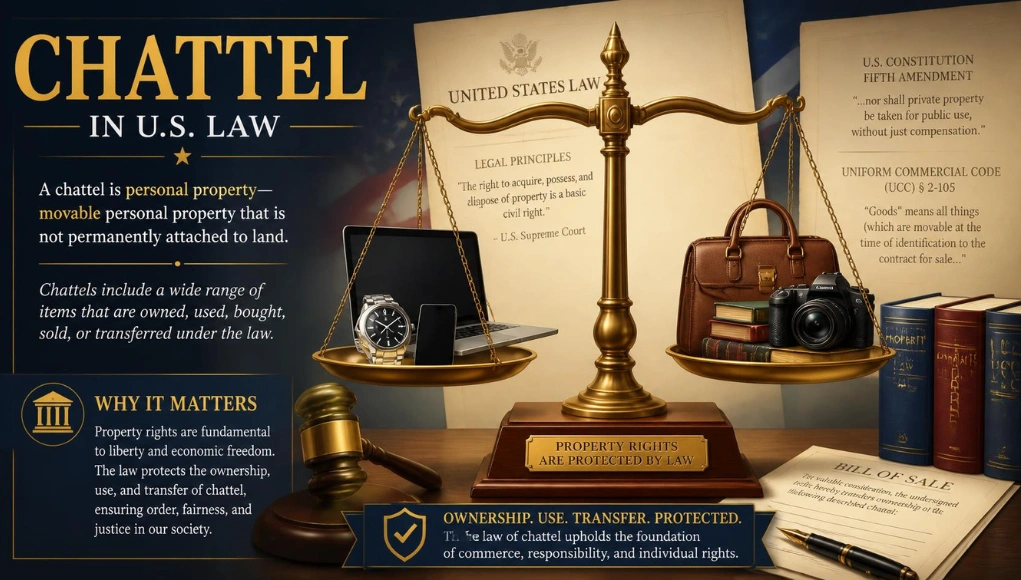
The chattel definition is fairly simple in modern American usage: it usually means tangible personal property that can be moved from one place to another. Cars, furniture, machinery, jewelry, and livestock are common examples. The term appears most often in property law, secured lending, estates, insurance, and older legal documents. You might also like Is blackmail illegal.
Direct answer: “Chattel” generally means movable personal property rather than land or buildings. In modern US legal usage, it often refers to physical items such as vehicles, furniture, equipment, or livestock. Older common-law meanings were broader, so the exact legal meaning can depend on the document, jurisdiction, and context in which the word appears.
| Key point | Meaning |
| Basic meaning | Movable personal property |
| Common examples | Cars, furniture, machinery, jewelry, livestock |
| Usually excluded | Land and permanently attached buildings |
| Legal category | Personal property |
| Common US contexts | Property disputes, loans, estates, tort law |
| Related terms | Personal property, goods, movable property |
| Historical use | The term could describe property broadly and was also used in systems that treated enslaved people as property. |
What Is the Chattel Definition in US Law?
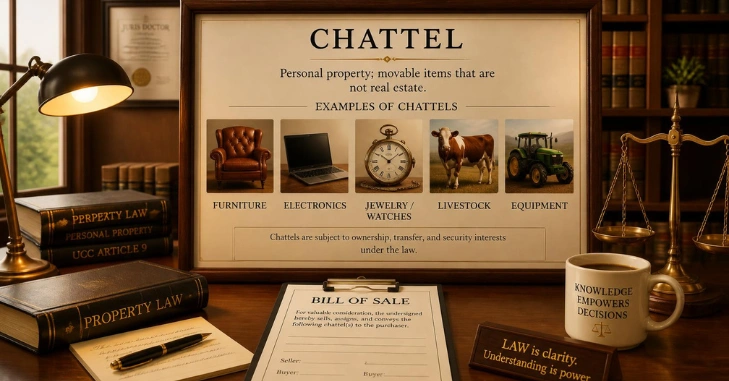
In US property law, chattel commonly refers to an item of personal property rather than real estate. Chattel definition: Modern legal usage generally focuses on tangible goods that can be moved. That distinction matters because American law often treats movable possessions differently from land. A car can be transferred, pledged as collateral, damaged, stolen, or wrongfully retained without changing ownership of the land where it happens to sit.
In everyday language, you can usually think of the term as a movable possession. Legal documents may use it more precisely, though, so the surrounding language matters. The modern meaning is narrower than some older common-law definitions. Historically, the category could include a broader set of property interests.
Common Examples of Chattels
The easiest way to understand the term is to compare ordinary movable belongings with real estate.
Typical examples include the following.
- Cars, trucks, motorcycles, and trailers
- Furniture and household appliances
- Jewelry, watches, artwork, and collectibles
- Business machinery, tools, and equipment
- Farm animals and other livestock
- Boats and certain recreational equipment
- Inventory and physical goods owned by a business
These objects can generally be removed or transferred without transferring ownership of the land itself.Suppose a homeowner sells a house containing a freestanding dining table. The house is real property. The table is personal property and would normally remain a separate movable asset unless the sale agreement provides otherwise.
A built-in cabinet presents a different question. Once an item becomes sufficiently attached to real estate, the law may classify it as a fixture rather than ordinary movable personal property.
Chattel vs. Real Property
The central distinction concerns the type of property and its relationship to land.
| Property type | Typical examples | Usually movable? | Connected to land? |
| Movable personal property | Car, sofa, jewelry, equipment | Yes. | No |
| Real property | Land, house, commercial building | No | Yes. |
| Fixture | Built-in cabinet, permanently attached equipment | Usually no | Yes. |
| Intangible personal property | Certain rights or financial interests | Not physical | No |
Real property generally includes land and things permanently attached to it. Personal property covers possessions and property interests that aren’t classified as real estate.
The distinction can become less clear when an object is attached to a building. A refrigerator that can be unplugged and removed is usually easier to classify than a furnace installed as part of a home’s heating system.
Contracts also matter. Buyers and sellers can specify whether particular items remain with a property after a sale. If you’re interested in the wider financial side of property ownership, Newsloger’s breakdown of Jennifer Dulos’s net worth shows how different forms of wealth can appear within a person’s broader financial picture.
Why the Term Matters in Loans and Secured Transactions
Movable assets can sometimes serve as collateral for a loan. A lender may take a security interest in a vehicle, machinery, equipment, inventory, or another qualifying asset. Older documents may use the phrase “chattel mortgage.” It refers to a lending arrangement in which movable personal property secures a debt rather than real estate.
For the key US legal point, the Cornell Legal Information Institute states that modern arrangements once called chattel mortgages are generally referred to as security agreements and are governed by Article 9 of the Uniform Commercial Code.
That classification can have practical consequences. The legal rules may determine how a lender establishes its interest, what happens after default, and how competing claims to the same property are handled.
Consider a company that finances expensive manufacturing equipment. The machinery is physically movable, but a lender may hold a security interest in it while the debt remains unpaid.
A consumer may encounter a similar idea when financing a vehicle. The borrower uses the vehicle, while the lender retains rights connected to the loan until the obligation is satisfied.
Readers exploring how lenders assess assets and repayment risk can continue with Newsloger’s loan approval factors guide, which discusses collateral alongside income, credit, loan purpose, and other considerations.
What Is Trespass to Chattels?
The term also appears in tort law. Trespass to chattels generally involves intentional interference with movable personal property possessed by another person. It differs from trespass to land because the subject is personal property rather than real estate.
Imagine that someone intentionally takes another person’s equipment and interferes with its use. Depending on the facts and applicable state law, that conduct may raise a claim involving interference with personal property.
A more serious interference may fall under the tort known as conversion. Conversion generally concerns substantial interference with another person’s rights in personal property.
The distinction matters because legal remedies can depend on what happened to the property, how serious the interference was, and which state’s law applies.
Chattel Personal and Chattel Real
Older legal terminology sometimes separates the concept into “chattel personal” and “chattel real.”
“Chattel personal” traditionally refers to movable personal property. Furniture, equipment, vehicles, and livestock are familiar examples.
“Chattel real” is an older common-law expression for certain interests connected with real estate that are nevertheless treated as personal property. A leasehold interest is the classic example.
Most general readers today are far more likely to encounter the first meaning. The second may still appear in historical cases, property-law materials, leases, and older legal documents.
This helps explain why definitions aren’t always worded identically. A modern dictionary may emphasize physical movable goods, while an older legal text may preserve broader categories inherited from common law.
Is Intellectual Property a Chattel?
This question shows why context is important. Patents, copyrights, trademarks, and similar rights are forms of intangible property. They have economic value, but you can’t physically move them in the same way as a car, machine, or piece of furniture.
Some historical or broad definitions of personal property may encompass intangible interests. Modern use of “chattel,” however, often focuses more narrowly on tangible movable property.
Because terminology differs across legal settings, it is better to identify the specific property right involved instead of assuming that every form of personal property falls under the same label.
For a related look at nonphysical property rights, Newsloger’s article on Solve Intelligence and AI patent drafting discusses intellectual-property workflows and legal technology.
Chattel and Fixtures Are Not the Same Thing
One area that frequently creates confusion is the difference between movable property and a fixture. A fixture often begins as an ordinary movable object. After it is attached to land or a building in a sufficiently permanent way, it may become associated with the real property.
For example, a freestanding lamp is movable personal property. A permanently installed lighting system may be treated differently.
The exact result can depend on several factors.
- How firmly the object is attached
- Whether removing it would damage the property
- Why it was installed
- What the parties agreed on in a contract
- The law of the state involved
This issue often matters during real estate transactions. Buyers and sellers may disagree about appliances, equipment, shelving, lighting, or other objects unless the contract clearly states what remains.
Where Did the Word Come From?
The word has a long history in English and property law. Its roots are connected with older French and medieval Latin terms associated with possessions and wealth. The English words “chattel” and “cattle” also developed from related linguistic roots.
That background helps explain why livestock remains a familiar example in descriptions of movable property. The word also carries an important and disturbing historical meaning. Under chattel slavery, enslaved human beings were legally treated as property that could be bought, sold, inherited, and transferred.
That historical use is different from the ordinary modern property-law definition, but it remains essential to understanding the word’s meaning in American history.
Today, describing a person as someone’s “chattel” generally conveys the idea that the person is being treated as an object or possession rather than as an autonomous human being.
Why Legal Definitions Can Vary
You may find one source that defines the word strictly as tangible movable property and another that gives it a broader meaning. That difference isn’t automatically an error.
Legal terminology develops over time. Common-law categories can also differ from terminology used in modern statutes, contracts, commercial rules, or individual states.
A general dictionary may emphasize ordinary current usage. A legal reference may preserve older distinctions because they still appear in court opinions and historical documents.
Context is especially important when the word appears in documents like these.
- A will or estate document
- A lease
- A loan agreement
- A security agreement
- A court filing
- An insurance policy
- A statute or regulation
- A real estate contract
When significant property rights depend on the classification, the document itself and the governing state law should be reviewed carefully.
Why the Definition Still Matters Today
“Chattel” may sound old-fashioned, but the underlying distinction between movable personal property and real property remains relevant. The classification can affect lending, property transfers, commercial transactions, lawsuits, estate administration, insurance disputes, and other legal questions.
It also helps readers understand related terms such as collateral, fixtures, security interests, conversion, personal property, and real property.
For an ordinary reader, the basic rule is simple: start by asking whether the property is a movable physical possession or part of the land.
If it is movable and tangible, it will often fit the modern meaning. If it is land or permanently attached to land, it will generally fall into a different property category.
The Bottom Line
For most US readers, the simplest meaning is movable personal property. Think of cars, furniture, machinery, livestock, jewelry, and similar physical possessions rather than land or buildings.
The chattel definition matters because American law distinguishes personal property from real property in several contexts. Those distinctions can influence secured loans, property disputes, sales, estates, and other transactions.
Older legal documents may use the term more broadly than modern sources do. If a contract, statute, estate document, or lawsuit turns on the classification, check the wording and the applicable state law rather than relying only on a general dictionary definition.
Frequently Asked Questions
What does “chattel” mean in simple words?
It means personal property, usually a physical item that can be moved. Cars, furniture, machinery, jewelry, and livestock are straightforward examples.
What is the chattel definition compared with personal property?
The terms overlap, but personal property can be broader. Modern US usage commonly uses “chattel” for tangible movable possessions, while personal property may also include certain intangible property rights.
Is a car considered chattel?
Yes. A car is a common example because it is a tangible possession that can be moved and is separate from land.
Is a house considered chattel?
Normally, no. A house permanently attached to land is generally treated as real property. Movable belongings inside the house may remain personal property.
Can furniture be considered chattel?
Yes. Freestanding furniture is a standard example of movable personal property. Furniture that becomes permanently incorporated into a building may raise a fixture question.
What is a chattel mortgage?
It is an older term for a lending arrangement secured by movable personal property, such as machinery or a vehicle. In modern US commercial practice, similar transactions are generally structured through security agreements.
Is money considered chattel?
Historical common-law definitions could treat money as part of the broader category. Modern usage of the word often focuses on tangible movable possessions, so the answer may depend on the legal context.
Are patents and copyrights chattels?
Patents and copyrights are intangible property rights. Because modern usage often limits the term to tangible movable property, it is better to identify such rights specifically as intellectual property rather than assume the label applies.