
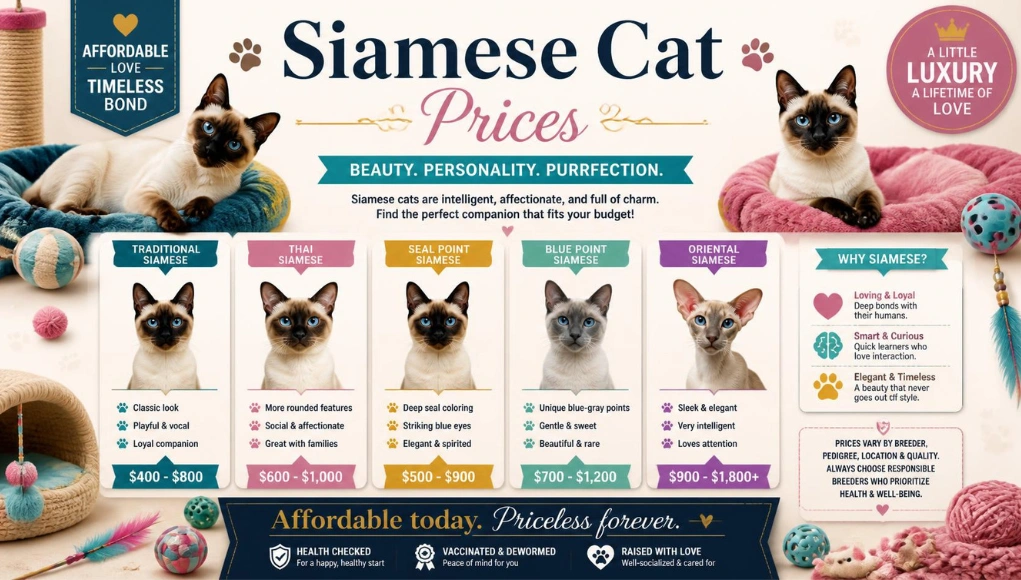
For U.S. buyers, Siamese cat price varies sharply depending on whether you adopt, buy a pet-quality kitten, or choose a showline pedigree. Current 2026 guides put rescue or shelter fees at roughly $75–$300, while reputable-breeder kittens commonly fall around $600–$1,200. Show-quality animals or kittens from sought-after pedigrees can reach $1,200–$2,500 or more.
The purchase fee is only the first part of your budget. Food, litter, veterinary care, vaccinations, a carrier, scratching furniture, toys, and possible insurance can make the first year considerably more expensive than the kitten itself. Knowing what should be included in a breeder or rescue fee also helps you distinguish a fair price from a suspiciously cheap listing.
Quick answer: In the United States, adopting a Siamese or Siamese-type cat often costs about $75–$300. A pet-quality kitten from a responsible breeder commonly costs around $600–$1,200, while show-line kittens may cost $1,200–$2,500+. Your total first-year budget should also account for supplies, veterinary care, food, and emergencies.
| Purchase route | Typical U.S. planning range | What you may receive |
| Shelter or general rescue | $75–$300 | Often basic veterinary preparation and spay/neuter |
| Retired breeder adult | $200–$500 | Adult with established temperament; inclusions vary |
| Pet-quality breeder kitten | $600–$1,200 | Pedigree documentation, vaccinations, and health records may be included. |
| Show-quality or premium pedigree | $1,200–$2,500+ | Show potential or established bloodlines. |
| Ongoing ownership | Varies widely | Food, litter, veterinary care, supplies, insurance, and emergencies |
These ranges are planning figures rather than fixed national prices because individual organizations and breeders set their own fees. Current U.S.-focused sources overlap most consistently around the ranges shown above, although some breeder prices extend beyond them. Adoption fees also vary by shelter, location, age, and the medical care already provided.
Key Takeaways
- Adoption is normally the lowest-cost route, although a shelter label does not guarantee a documented pedigree.
- A responsible breeder may charge more because veterinary care, registration, socialization, and health screening add real costs.
- An unusually cheap kitten deserves extra scrutiny rather than an immediate deposit.
- Budget for ownership after purchase, not only the advertised kitten price.
- Registration, health records, and breeder transparency matter more than paying extra for a fashionable color label.
How Much Does a Siamese Cost in the United States?
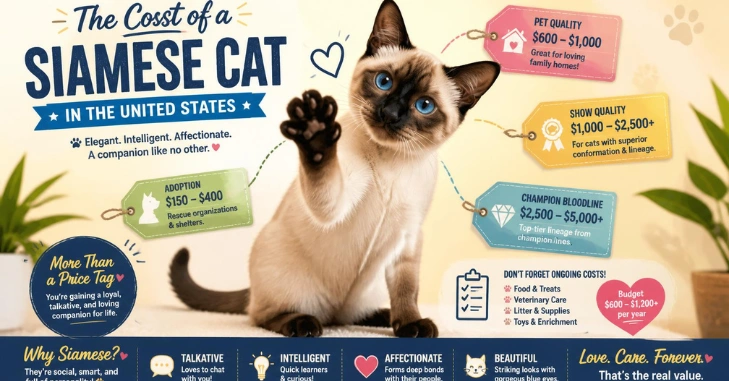
A pet-quality kitten from an established breeder commonly lands around $600 to $1,200, although individual catteries may charge less or considerably more. WebMD gives a broader breeder range of about $600 to $2,500, while recent Catster and Petful guides also show substantial variation according to pedigree and intended quality. That spread is why a single national “average” can be misleading.
Siamese cat price adoption is typically much cheaper because a shelter is placing a companion rather than selling a documented pedigree. Adopt a Pet estimates about $75 to $100 for shelter or rescue adoption, while other current guides stretch that range toward $200 or $300. ASPCA explains that adoption fees commonly help cover veterinary treatment, vaccinations, food, and spay or neuter services, although what is included differs by organization.
Readers looking for more animal-related coverage can also browse the Newsloger Pets section. That section collects ownership, breed, and general pet-care guides in one place. Reading a few of them alongside this one makes it easier to compare what different pets cost to keep.
Rescue, Breeder, or Retired Adult: Which Route Costs Less?
A rescue is normally the least expensive choice, but availability can be unpredictable when you want a specific pedigree, sex, age, or traditional point color. Cats described as Siamese at shelters may also be mixes with the breed’s familiar pointed appearance rather than pedigreed animals. That distinction matters if pedigree documentation is one of your reasons for searching.
A less-discussed middle ground is a retired breeding adult. Current pricing guides place some retired adults around $200 to $500, which can provide substantial savings compared with a kitten. An adult also has a more established temperament, giving you more information about activity level and personality before making a commitment.
| Option | Main advantage | Main tradeoff |
| Rescue | Lowest typical entry cost | Pedigree and exact background may be unknown. |
| Retired adult | Lower price than many kittens | Fewer available choices |
| Pet-quality breeder | Documented breeding background | Higher upfront expense |
| Show-line kitten | Pedigree and show potential | Highest typical purchase price |
What Affects Siamese Cat Price in the United States?
Pedigree is one of the biggest factors. A kitten produced primarily as a household companion normally costs less than one sold as a show prospect or with breeding rights. Age can also change the figure because older kittens and retired adults may be priced below young kittens with strong demand.
The services included in the fee matter as much as the number itself. Vaccinations, veterinary examinations, registration paperwork, microchipping, genetic screening, and a written health contract all cost money, so two apparently similar listings may offer quite different value. Ask for an itemized explanation before comparing breeders purely on price.
Color terminology deserves extra care because registries do not always classify every seller-used color name in the same way. The Cat Fanciers’ Association lists seal, chocolate, blue, and lilac as the traditional Siamese point colors. If a seller wants a substantial premium for a supposedly rare variation, verify exactly how the kitten is registered instead of paying for a marketing label.
What Should a Higher Breeder Price Include?
A higher fee should buy more than an attractive kitten photograph. At minimum, you should be able to verify who bred the litter, what veterinary work has been completed, whether registration claims are accurate, and what protections appear in the purchase contract. A responsible breeder should also be willing to discuss the health history of the breeding lines instead of treating those records as unnecessary.
CFA notes that progressive retinal atrophy can occur in the breed and that the relevant recessive gene can be detected through genetic testing. TICA also discusses genetic screening and provides a breeder directory for buyers seeking member catteries. These resources do not remove the need to investigate an individual breeder, but they give buyers useful places to begin.
Before sending a deposit, ask for:
- A written sales contract and health guarantee.
- Veterinary and age-appropriate vaccination records.
- Registration details if the kitten is advertised as registered.
- Relevant genetic-testing information for the parents.
- The kitten’s age and expected go-home date.
- Clear information about spay or neuter requirements.
- References, reviews, or another way to verify the cattery’s history.
How to Avoid Paying Too Much or Falling for a Scam
The lowest advertised number is not automatically the best deal. TICA’s Pet Buyer’s Guide advises buyers to research normal breed prices, verify breeder credentials, look for reviews, and visit the breeder when possible. A dramatically underpriced kitten paired with pressure for an immediate deposit should therefore prompt additional verification.
Use a simple price-to-proof rule when comparing offers. As the asking price rises, the breeder should be able to show stronger documentation for pedigree, veterinary care, health screening, registration, and what is included. If the evidence does not improve with the price, paying more may give you little extra value.
TICA also maintains listings of member breeders and states that breeders appearing through its Siamese resources have signed its Code of Ethics. CFA provides its own breed information and breeder-finding resources as another starting point. Neither directory should replace your own checks, so verify the individual breeder, contract, health records, and living conditions before money changes hands.
Remember the Cost After You Bring Your Kitten Home
The initial payment can distract buyers from the larger ownership budget. You’ll need food, litter, bowls, a carrier, scratching surfaces, toys, routine veterinary care, parasite prevention where appropriate, and money for unexpected treatment. Catster’s 2026 guide estimates a broad $750–$4,175 range for one-time costs, including acquisition and setup, illustrating how widely household choices can change the total.
Monthly spending also varies substantially with food choices, veterinary needs, insurance, location, and optional products. Catster places its broad monthly estimate between $115 and $600, but the upper end should not be treated as a required monthly bill for every owner. A safer budgeting method is to price food, litter, local veterinary services, and insurance in your ZIP code before committing to the kitten.
Your home setup does not need to be expensive, but it should give an active, social animal places to climb, scratch, hide, and rest. Owners considering an enclosed outdoor retreat can borrow ideas from Newsloger’s guide to building a weather-protected outdoor structure. Indoor living and supervised outdoor access remain easier ways to control many environmental risks.
A Practical Budget for Three Types of Buyers
The table below separates the acquisition decision from the rest of ownership, which makes comparisons easier. It avoids pretending that food and veterinary prices are identical in California, Texas, Florida, New York, or smaller U.S. markets. Use the purchase range as a starting point, then obtain local prices for the recurring expenses that apply to your household.
| Buyer profile | Acquisition budget | Best budgeting approach |
| Adoption-focused | About $75–$300 | Ask what veterinary work the fee already covers. |
| Companion-pedigree buyer | About $600–$1,200 | Compare breeder documentation and included care. |
| Show-line buyer | About $1,200–$2,500+ | Confirm the pedigree, registration, and purpose of the premium. |
This method can prevent a common budgeting mistake: spending the entire pet budget on the purchase itself. A $1,000 kitten with no emergency reserve can put an owner in a weaker position than a $700 kitten followed by several hundred dollars kept for veterinary needs. The responsible choice is the one your household can continue supporting after the initial excitement passes.
Is a Siamese Worth Paying More For?
Price should come after lifestyle fit. TICA describes the breed as highly social and people-oriented, while CFA characterizes it as vocal, affectionate, and active. A household that wants an independent pet that spends most of the day alone may therefore find another temperament easier to live with.
If you want an interactive companion, the breed’s sociability can be a major part of its appeal. You should still choose health, temperament, and responsible sourcing ahead of pedigree prestige or a fashionable appearance. Paying more makes sense only when the extra money reflects something meaningful and verifiable.
The Bottom Line
Most U.S. shoppers should expect adoption to cost a few hundred dollars or less, while a responsibly bred companion kitten often moves into the high hundreds or low four figures. Show lines can climb much higher, but the advertised figure should always be considered alongside veterinary records, pedigree documentation, health screening, and contract terms. The smartest purchase is not automatically the cheapest or the most expensive one.
Siamese cat price Set your budget for the cat and the first year of ownership before contacting sellers. Then compare reputable breeders, rescues, and available adults based on health, temperament, documentation, and the care already included in the fee. For more related content as Newsloger expands its animal coverage, readers can continue through the Pets category or browse broader home-and-family topics in Newsloger’s Lifestyle section.
Frequently Asked Questions
What is the average Siamese cat price in the US?
For planning purposes, rescue fees commonly fall around $75–$300, while a pet-quality breeder kitten often costs about $600–$1,200. Show-oriented or premium-pedigree animals can reach roughly $1,200–$2,500 or more. Exact prices depend on breeder, location, age, pedigree, and what veterinary services are included.
How much does a Siamese kitten from a breeder cost?
Many current U.S. guides cluster pet-quality breeder kittens around $600–$1,200, although broader published ranges extend beyond that figure. Show prospects and particular pedigrees may cost substantially more. Instead of choosing from price alone, compare contracts, registration, health records, and breeder transparency.
Is adopting one cheaper than buying from a breeder?
Yes, adoption generally has the lowest upfront fee. Shelter and rescue charges may also cover part of the veterinary preparation already completed, such as vaccinations or spay and neuter services. Ask the individual organization exactly what its fee includes because policies vary.
Why are some Siamese kittens so expensive?
Higher prices can reflect pedigree, show potential, breeding rights, veterinary care, health screening, registration, and the breeder’s operating costs. Those factors do not automatically make every expensive listing worthwhile. The seller should be able to document the reasons behind a premium price.
Should I buy the cheapest kitten I can find?
A low price can be legitimate, especially for an adult, rescue placement, or private rehoming situation. It can also signal missing health records, undocumented breeding, or an online scam, so verification matters. TICA specifically recommends researching normal pricing and checking breeder credibility before purchasing.