

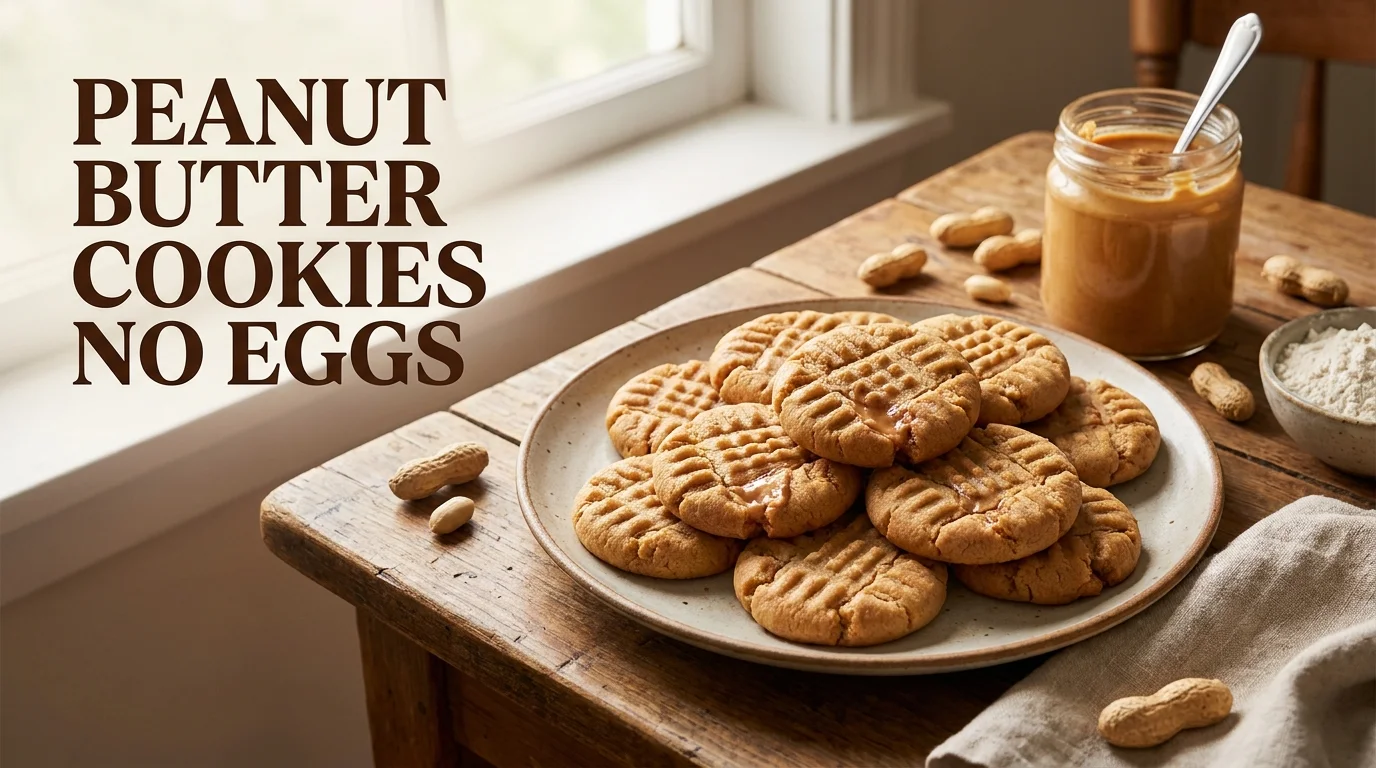
The carton is empty. That’s egg-ally where baking stops, except peanut butter is already doing most of an egg’s work before you crack anything. Search for peanut butter cookies no eggs and page on e contradicts itself within three clicks. One recipe insists on natural jars where the oil separates. The next insists on stabilized jars like Jif and Skippy, and warns that natural peanut butter will ruin the batch. Both camps are telling the truth about their own recipe, and the deciding factor is whether flour is in the bowl.
Short answer: replace the egg with two tablespoons of milk and use powdered sugar instead of granulated. Beat one cup of peanut butter with the sugar and milk, roll twelve balls, flatten each with a fork, then bake at 350°F for 9 to 11 minutes. They firm up on the pan as they cool.
Recipe at a glance
| Detail | Flourless version |
|---|---|
| Active time | 10 minutes |
| Bake time | 9 to 13 minutes |
| Oven | 350°F, middle rack |
| Yield | 12 cookies |
| Core ingredients | Peanut butter, confectioners’ sugar, milk |
| Binder instead of egg | Sugar syrup plus the fat and protein in the nut butter |
| Texture | Chewy center at 9 minutes, snappy at 13 |
| Keeps | 5 days sealed, 3 months frozen |
Key takeaways
- An egg brings water, protein, and emulsifying power. Sugar plus a splash of dairy covers the first two jobs well enough.
- Flourless dough wants a stabilized jar. Flourless dough can take natural peanut butter.
- Weigh the peanut butter if you can. A scooped cup swings by an ounce and a half.
- Underbaking by two minutes is what makes these chewy rather than sandy.
What replaces the egg, and why it works
An egg does three separate jobs in a cookie. It adds water, it adds protein that sets in the oven and holds the crumb together, and its yolk emulsifies fat into the batter so nothing splits.
Peanut butter quietly handles two of those already. Check a jar label, and a two-tablespoon serving carries roughly 7 to 8 grams of protein and 16 grams of fat. That is a lot of structure and richness sitting in the bowl before you add anything else.
So the binder that replaces the egg is not one ingredient. It is a partnership: sugar dissolved into a small amount of liquid forms a syrup, and that syrup glues the peanut solids together as it cools and sets.
Which is exactly why powdered sugar behaves better here than granulated. Confectioners’ sugar dissolves instantly and carries cornstarch, and the cornstarch soaks up loose oil. Granulated crystals stay gritty in a dough this dry and leave you with a sandy bite.
Milk supplies the water the egg would have brought—maple syrup or aquafaba do the same job if you need the cookies dairy-free.
What you’ll need
Two versions follow. First, the fast flourless one. Second, a tray-bake sort for when you want twenty cookies rather than twelve.
Flourless, three-ingredient confectioners’
- 1 cup creamy peanut butter, 9 1/2 ounces, stabilized brand
- 1/2 cup confectioners’ sugar, 4 ounces
- 2 tablespoons whole milk
- 1/2 teaspoon vanilla extract
- Pinch of kosher salt
Flour-based, eggless
- 1/2 cup softened butter, 4 ounces
- 1/2 cup peanut butter, 4 3/4 ounces
- 1/2 cup packed brown sugar, 3 3/4 ounces
- 1/4 cup granulated sugar, 1 3/4 ounces
- 3 tablespoons milk
- 1 1/4 cups all-purpose flour, 5 1/4 ounces
- 1/2 teaspoon baking soda and 1/4 teaspoon salt
Those weights matter more than any tip below. No result on page one gives a weight in ounces for a cup of peanut butter, yet it is the single biggest source of failure. A cup scooped loose from a soft jar differs from a cup packed hard from a cold jar by roughly an ounce and a half. Scooped cups vary enough to turn a chewy dough greasy.
Equipment is short: a sturdy bowl, a fork, a half sheet pan and parchment. A conventional home oven is fine. Baking through August without heating the house is another matter. The same trays work in a countertop oven, or in a proper oven bay if you are building an outdoor kitchen.
How to make peanut butter cookies no eggs, step by step
- Heat the oven to 350°F and line a sheet pan with parchment. Set the rack in the middle.
- Stir the peanut butter smooth in a medium bowl. If it came from the fridge, give it 20 seconds in the microwave first.
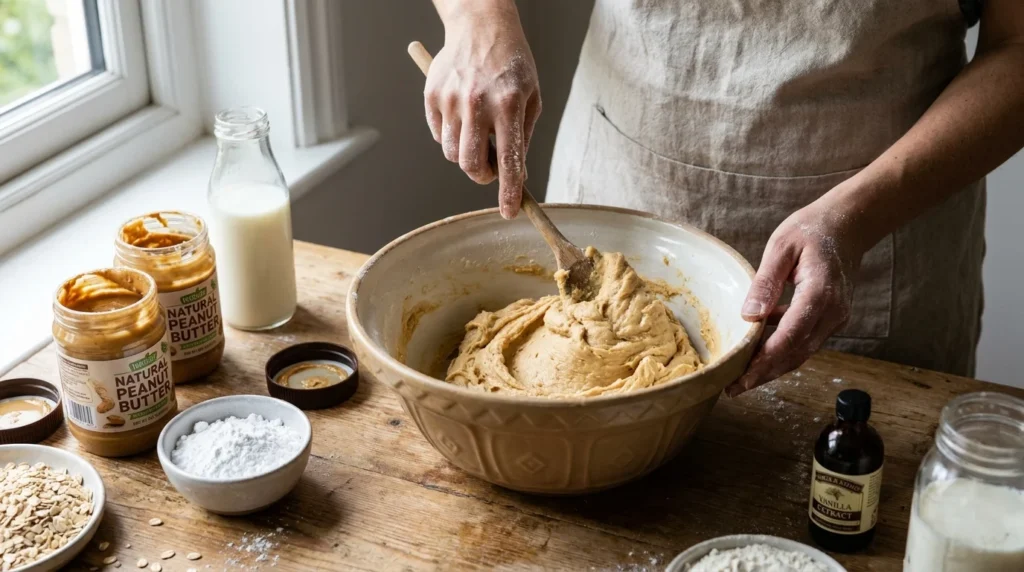
- Add the sugar, milk, vanilla, and salt. Beat hard with a wooden spoon for a full minute. The mixture goes from slack to stiff and pulls away from the bowl.
- Roll 12 balls of about 1 1/2 ounces each. Wet hands to stop the dough sticking.
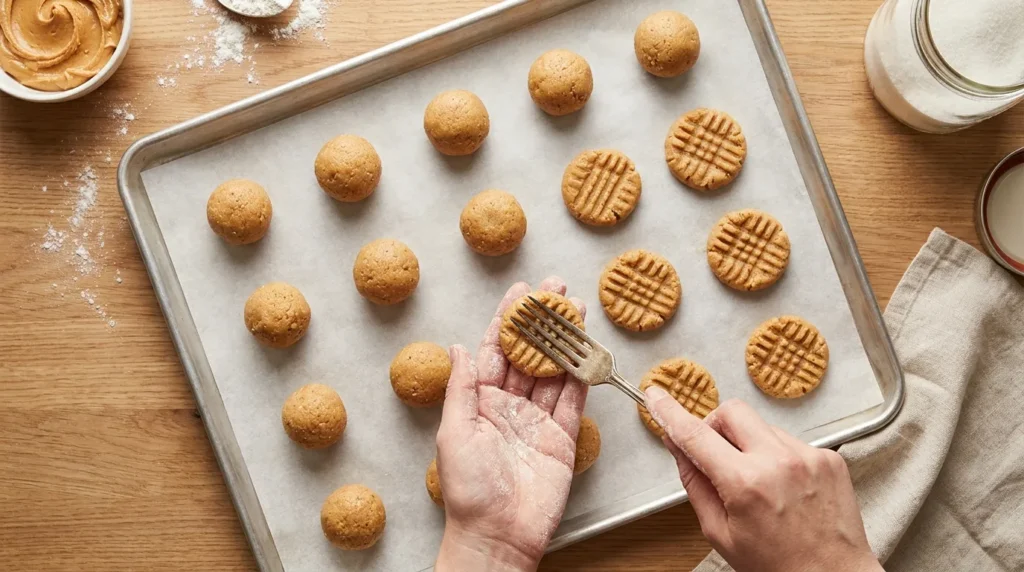
- Press a fork criss-cross into every ball, twice, at right angles, until each one is about half an inch thick.
- Bake for 9 to 11 minutes. Pull them while the centers still look soft and the edges have barely colored.
- Cool on the pan for 10 minutes. This is not optional. Move them early, and they break.
For the flour-based dough, cream the butter and both sugars first, beat in the peanut butter and milk, then fold in the flour, soda, and salt. Chill it for 30 minutes. Bake at 350°F for 10 to 12 minutes.
Why the fork press matters when there is no egg
Peanut Butter Cookies No Eggs: Everyone shows the criss-cross. Nobody explains why it is structural rather than decorative here. An egg white puffs and sets in the heat, which lifts a normal cookie and then spreads it. Remove the egg, and there is nothing to do the lifting, so the ball mostly stays a ball. Outside browns, middle stays raw and pasty.Pressing the dough flat fixes that in one move. It also thins the center so it finishes cooking at the same moment as the rim. A fork gives you an even thickness faster than your palm does.
Natural or stabilized: settling the argument
Here is the rule the top results miss. Match the peanut butter to the amount of flour, not to a brand preference.
| Your recipe | Use | Because |
|---|---|---|
| Flourless, sugar and nut butter only | Stabilized: Jif, Skippy, Peter Pan | The palm oil keeps the dough emulsified with no starch to absorb loose oil |
| Flour-based, butter and flour present | Natural, stirred well | Flour absorbs the free oil, and natural jars taste more strongly of peanut |
| Either recipe, no-stir natural | Safe in both | It is stabilized in practice despite the label wording |
Follow that and the contradiction disappears. One camp writes flourless recipes. The other writes flour-based recipes. Neither says so. Skip crunchy, flour-based in the flourless version. Nut pieces interrupt the sugar network that is holding everything together.
Chewy or crisp: where the bake times split
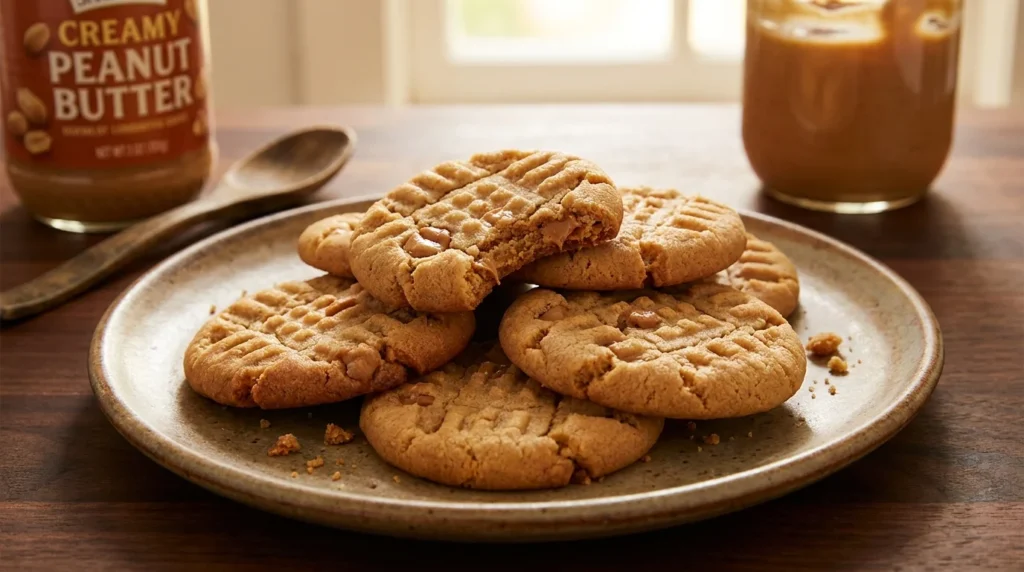
Two minutes is the whole difference. No page gives separate bake times for chewy versus crisp eggless cookies, so bakers guess and land in the middle, where the texture is neither.
| You want | Bake at 350°F | Pull when |
|---|---|---|
| Soft and chewy | 9 minutes | Centers look wet, edges pale |
| Middle ground | 11 minutes | Edges just golden |
| Crisp and snappy | 13 minutes | Golden across the whole top |
Set a timer for nine minutes on the first tray and judge from there. Ovens run hot or cold by 25 degrees quite happily, and eggless dough has less margin than the usual kind.
Fixes for crumbly dough and cookies that fall apart
Most of the trouble reports come down to three causes, and each has a fix you can apply mid-batch.
- Dough crumbles and will not roll—too little liquid, or a dry natural jar. Add milk one teaspoon at a time until a squeezed handful holds.
- Dough is sticky and licky—too much oil. Add two tablespoons of powdered sugar, or chill for 20 minutes.
- Cookies fall apart lifting off the pan. You moved them hot. Wait the full 10 minutes; the sugar has to soften.
- Threw’dd into one sheet: granulated sugar, or a warm kitchen. Switch to confectioners’ and chill the tray before it goes in.
- Dry and sandy. Overbaked by three minutes, almost always.
Baking these with children is easy, since there is no raw egg in the bowl and the shaping is forgiving. Give them the fork job. Then park them with a round of Nintendo Switch games for kids while the trays cool properly.
Flourless versus flour-based, side by side
Nobody compares the flourless, three-ingredient version directly against the flour-based, eggless recipe, so here is that comparison.
| Factor | Flourless, three ingredient | Flour-based, eggless |
|---|---|---|
| Total time | 20 minutes | 55 minutes with chilling |
| Yield | 12 | 20 |
| Texture | Dense, fudgy, strongly peanut forward | Lighter, closer to a bakery cookie |
| Gluten free | Yes | Only with a 1:1 blend |
| Vegan | Yes with plant milk | Needs vegan butter too |
| Forgiving of bad measuring | No | Yes |
Pick the flourless one for speed and for the pure peanut flavor. Pick the flour-based one when you are feeding a crowd.
Storing flour-based dough balls
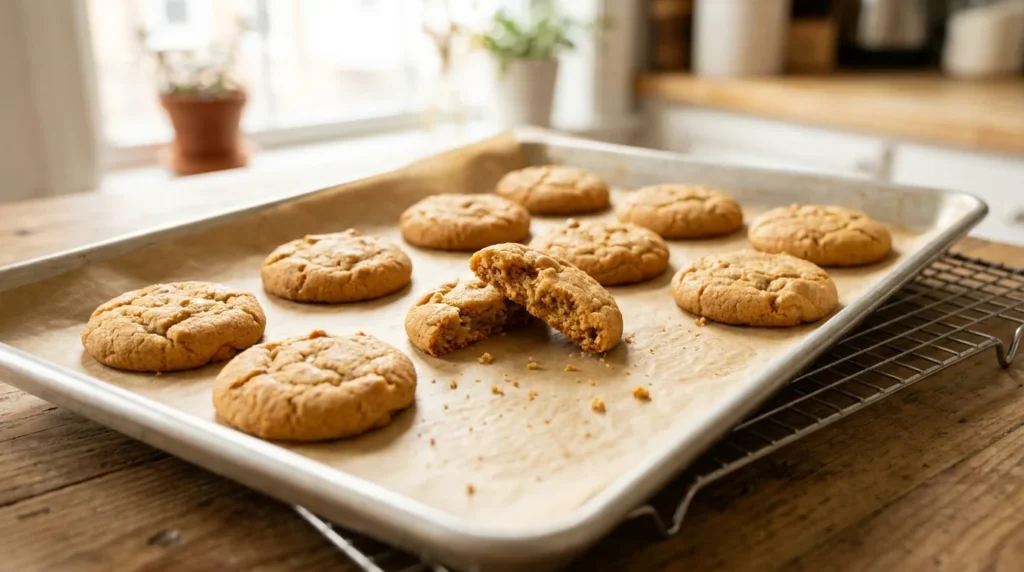
Baked cookies keep five days in an airtight container at room temperature. Put a slice of sandwich bread in with them, and the chewy ones stay chewy for the whole five. Freezing raw dough is the better trick, and no page covers it properly for eggless dough. Roll and press the balls first, freeze them flat on a tray for an hour, then bag them for up to three months. Bake straight from frozen and add two or three minutes of extra bake time. Baked cookies also freeze for three months. Thaw at room temperature for 30 minutes. Crumbs travel, of course. If the container gets carried to the sofa, you may end up needing to clean a rug before the week is out.
Bake a tray tonight
Get the oven to 350°F, weigh out 9 1/2 ounces of peanut butter, and you are ten minutes from dough. Start with the flourless version, pull the tray at nine minutes, and note what your oven did. Adjust by one minute next time, and you will have a recipe that belongs to your kitchen rather than to the internet.
Frequently asked questions
Yes, and the timer decides it. Pull them at nine minutes with the centers visibly soft, then let them set on the hot pan. The residual heat finishes the job without drying the middle.
For this dough, use two tablespoons of milk plus powdered sugar. Aquafaba, mashed banana, and flax eggs also work, though banana pushes the flavor somewhere else entirely.
Yes, for the flourless version, if you swap the milk for oat or almond milk. Check the sugar too, since some American confectioners’ sugar is filtered through bone char.
It works in the flour-based recipe. In the flourless one, it stays gritty, and the cookies spread thin, so usconfectioners’s’ sugar there.
Not for the flourless version, unless your kitchen is above 78°F. The flour-based dough needs its 30 minutes, or it spreads.
Either an overbaked tray or a heavy hand with the flour. Weigh it at 5 1/4 ounces, and the problem usually goes away.


