

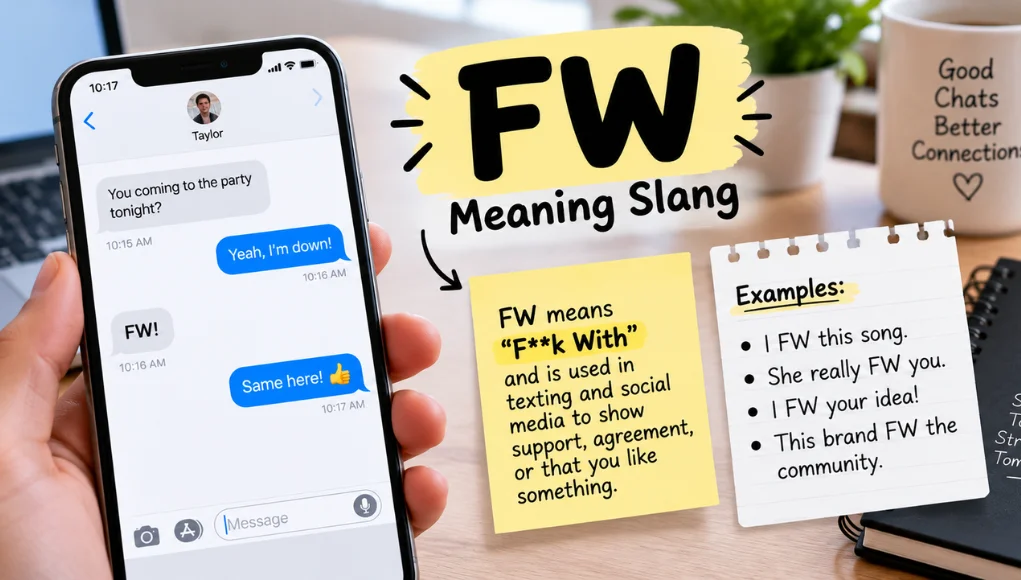
If you searched for FW meaning slang, you probably saw the abbreviation in a text, comment, caption, or direct message and wanted a quick translation. In casual U.S. online conversation, it usually stands for “fuck with,” which can express liking, support, respect, trust, or association. The exact tone depends on the surrounding words and the relationship between the people talking. More from us: Whats sahm.
Direct answer: In casual U.S. texting and social media, FW usually stands for “fuck with.” It commonly means you like, support, respect, trust, or enjoy someone or something. In negative wording, the same phrase can mean you dislike, reject, distrust, or avoid a person, idea, or situation.
| FW Meaning Slang | Typical meaning | Plain-English interpretation |
|---|---|---|
| Casual text or DM | “Fuck with” | Like, support, respect, or associate with |
| Positive comment | Approval | “I like this” or “I’m into this” |
| Negative sentence | Dislike or avoidance | “I don’t support this” or “I avoid them” |
| Email subject line | Forward | The message has been passed along. |
| Technical discussion | Firmware or firewall | Depends on the device or computing context |
TL;DR: Slang use is usually positive when someone praises a person, song, style, idea, or post. Adding words such as “don’t” can reverse that meaning and signal dislike or distrust. Email and technical uses are different, so context matters more than capitalization.
What Does FW Meaning Slang Mean in Texting?
The slang expansion is “fuck with,” but the phrase often sounds much harsher when written out than it feels in everyday texting. Dictionary.com identifies both the email meaning “forward” and the internet-slang meaning, while Wiktionary also lists the abbreviation as a texting initialism of the same phrase.
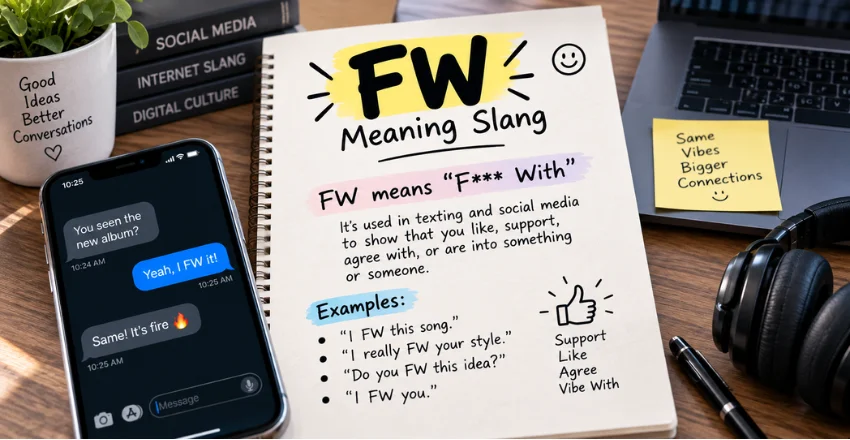
In a positive sentence, it can communicate approval, connection, or support. Someone talking about a new album, restaurant, creator, outfit, game, or friend may use the term much like “like,” “mess with,” or “vibe with” in everyday conversation. The slang sense is informal, so the meaning comes from conversational context rather than one rigid dictionary definition.
The phrase can also refer to association rather than simple enjoyment. If a person says they no longer associate with somebody, the message may imply a damaged friendship, lost trust, or a deliberate decision to keep distance. That makes the surrounding conversation especially important when the object is a person instead of a song, product, or idea.
What Does “I FW You” Mean? Mean?
“I fw you” usually means “I like you,” “I respect you,” “I support you,” or “I enjoy being around you.” It can communicate friendship or loyalty without necessarily carrying romantic meaning. The relationship between the sender and recipient gives the phrase most of its emotional weight. For example, a friend might say it after you help them through a problem or defend them in a group conversation.
In that setting, the phrase sounds closer to “you’re good with me” than a romantic confession. If the same wording appears during an obviously flirtatious conversation, though, it may signal romantic interest without proving it on its own. Gender does not create a separate definition. A girl, guy, or anyone else using the phrase can mean friendship, respect, attraction, or general approval depending on the conversation. Reading several messages together is more reliable than interpreting two letters in isolation.
Common Examples and What They Mean
Seeing the abbreviation inside a complete sentence makes the intended meaning easier to recognize. Positive sentences tend to express approval, while negative or warning-style sentences can communicate distance or irritation. These examples show how small wording changes can shift the message.
| Message | Likely meaning |
|---|---|
| “I fw this song.” | I like this song. |
| “Do you fw that idea?” | Do you like or support that idea? |
| “I don’t fw him anymore.” | I no longer trust, like, or associate with him. |
| “Don’t fw with me today.” | Don’t bother, provoke, or mess with me. |
Notice that the final example is different from simply liking something. The full phrase “fuck with” has long carried senses related to bothering, provoking, interfering with, or associating with somebody. Merriam-Webster and Oxford both document negative senses involving troublesome or provocative behavior, which explains why context can flip the tone.
How the Slang Works on TikTok, Snapchat, Instagram, and X
On TikTok, the abbreviation commonly appears as a short reaction to songs, videos, opinions, creators, outfits, and trends. Dexerto describes its TikTok use as an expression of liking, agreement, support, or enjoyment, which closely matches how it appears elsewhere online. Snapchat users may use the same shorthand in direct chats, story replies, and reactions.
Because conversations there can be brief and casual, the surrounding sentence may matter more than the abbreviation itself. If Snapchat terminology regularly confuses you, Newsloger also has a guide explaining what KMS means on Snap. Instagram and X use the term in much the same way, particularly in comments and replies.
A short approving reaction beneath a photo, post, or opinion usually signals support rather than confrontation. Readers interested in more social platforms and digital topics can also browse Newsloger’s Tech section.
How to Read the Context Correctly
Two letters are rarely enough to reveal someone’s complete intention, so read the full message before reacting. Tone, subject matter, previous messages, and the sender’s usual vocabulary all provide clues. A message about music or clothing will usually be easier to interpret than a short statement about another person.
- Look for positive or negative words around the abbreviation, especially “don’t,” “love,” “like,” “still,” or “anymore.”
- Check what the conversation is about, because a person, song, opinion, or email can produce different interpretations.
- Notice emojis and follow-up messages, but do not treat one emoji as proof of flirting or hostility.
- Ask what the sender means when the message affects a relationship or another important decision.
This approach also helps with other Snapchat language and features. Online shorthand often makes sense only after you understand how a specific platform or community uses it. Newsloger’s Snapchat Solar System guide offers another example of how platform-specific terms can confuse users when they first encounter them.
Is the Term Rude or Offensive?
The abbreviation represents a phrase containing profanity, so it remains informal even when the intention is friendly. Friends who routinely use casual slang may barely notice the swear-word connection, while coworkers, teachers, clients, or relatives may consider it inappropriate. Audience matters as much as meaning.
A positive message is usually less confrontational because it shows approval or support. A negative version aimed directly at another person can sound cold, dismissive, or aggressive. Safer alternatives include “I like that,” “I support that,” “I’m into it,” “I don’t agree with that,” or “I’d rather not deal with them.”
For that reason, the slang belongs mainly in informal texts, DMs, comments, and group chats. Professional email, school assignments, formal business messages, and customer communication call for clearer language. Using the full meaning rather than shorthand also reduces the chance of being misunderstood.
Is It Flirty or Romantic?
The abbreviation is not inherently romantic. A person can use it toward a friend, teammate, creator, coworker, artist, or somebody they are attracted to. The romantic meaning comes from the rest of the conversation, not the abbreviation alone. A compliment paired with invitations to meet, affectionate language, repeated personal attention, or obvious flirting may suggest more than friendship.
A casual message between longtime friends usually points toward respect or closeness instead. Avoid treating one short expression as definite evidence that somebody has romantic feelings. This distinction matters because search results often frame messages “from a girl” or “from a guy” as though gender changes the definition. It does not. The safer interpretation is to judge tone, relationship, and conversation history together.
Other Meanings You Might See
The most important alternative is “forward,” particularly in an email subject line. A subject such as “FW: Meeting Notes” indicates that an existing message has been passed to another recipient, and it has nothing to do with slang. Dictionary.com notes that this email usage has been around for decades.
Technical conversations can create other meanings, too. Wiktionary lists uses connected with firmware and firewall, while other niche contexts may use the letters for unrelated terms. The simplest rule is to identify the setting first. Casual social conversation points toward the slang sense, an email subject points toward “forward,” and a device-support discussion may point toward a technical abbreviation. Context eliminates most ambiguity within a few seconds.
Where Did the Slang Use Come From?
The positive “associate with, approve of, or enjoy” sense of the full phrase has roots in African American Vernacular English. Wiktionary identifies that particular sense as especially associated with African American Vernacular usage, while Dictionary.com notes that the shortened internet form was common by the 2010s.
Online communication helped make the shorter form practical because texts, tweets, comments, and chats reward quick wording. Social platforms then carried the expression to people outside the communities where it was already familiar. The abbreviation is now easy to encounter across mainstream U.S. social media.
That background also reminds us that internet slang does not always originate online. Digital platforms often shorten and spread expressions that first existed in spoken communities. Understanding that history gives readers more context than treating every viral abbreviation as a new invention.
The Bottom Line
The easiest way to decode this slang is to read the entire sentence, not the two-letter abbreviation alone. Positive wording normally signals liking, support, respect, or connection, while negative wording may signal dislike, avoidance, or confrontation. Email and technical contexts can give the same letters completely different meanings.
Keep this guide handy the next time a short text or social media comment leaves you unsure. For more explanations of online terminology and digital features, explore Newsloger’s Tech coverage and related Snapchat guides. Learning the context usually tells you more than memorizing a single definition.
Frequently Asked Questions
What does FW slang mean?
It usually refers to the phrase “fuck with” in casual texting or social media. Depending on the sentence, that can mean liking, supporting, trusting, respecting, associating with, or enjoying someone or something. Negative wording can instead communicate dislike, avoidance, or distrust.
What does “I don’t fw you” mean?
It usually means the sender does not like, trust, support, or want to associate with the other person. The wording can sound dismissive and may suggest an argument, broken friendship, or deliberate distance. Use the broader conversation to judge how serious the statement is.
Does it mean “friends with”?
People may interpret the abbreviation as involving friendship because “fuck with” can mean associating with or liking somebody. That does not make “friends with” its standard slang expansion, though. In casual online usage, the profanity-based phrase is the more widely documented meaning.
How should you reply when someone uses it?
Match the tone of the conversation and respond to the meaning rather than the abbreviation itself. If somebody is complimenting you, a simple “thanks,” “appreciate it,” or similar response works naturally. If the message is unclear or sounds confrontational, it’s safer to ask what they mean than to guess.