

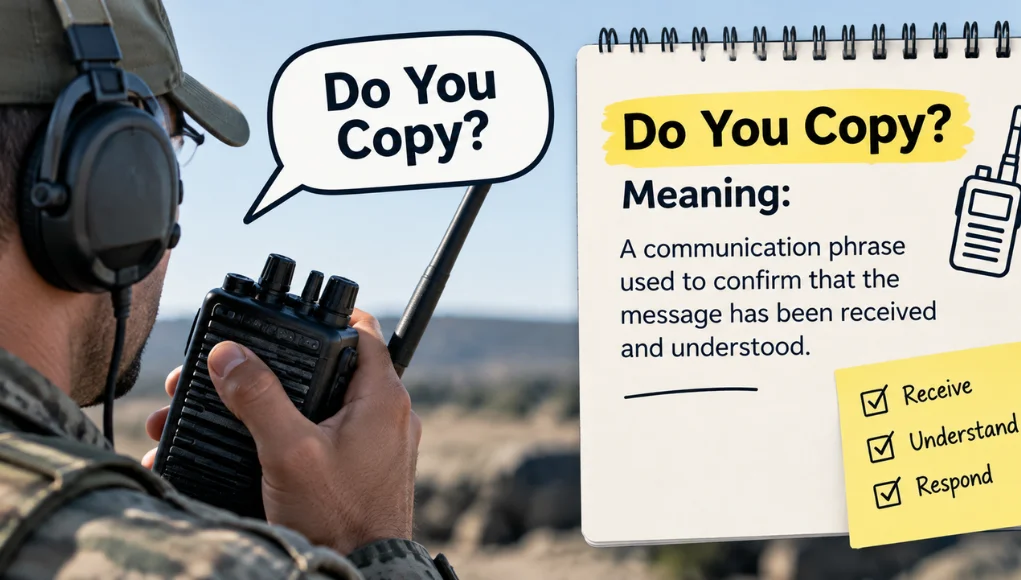
If you searched for “do you copy meaning,” the short answer is “Did you hear and understand me?” The expression is strongly associated with two-way radio communication, including military, emergency, and dispatch settings. Americans also use it casually to confirm that another person understood a message or instruction. More from us: I Understand You.
| Do You Copy Meaning | Explanation |
|---|---|
| Basic meaning | “Did you receive and understand what I said?” |
| Common reply | “Copy,” “Copy that,” or a clear confirmation |
| Traditional context | Two-way radio communication |
| Everyday U.S. use | Workplaces, gaming, joking conversation, movies, and texts |
| Does it mean “yes”? | Not necessarily; it mainly acknowledges a message. |
| Related terms | Roger, willco, over, out, and say again |
Direct answer: “Do you copy?” means “Did you receive and understand what I said?” It comes from radio communication, where short confirmations matter because messages can be interrupted or unclear. In everyday U.S. English, the phrase can also sound playful, dramatic, or slightly military, depending on the situation.
Key takeaways
- “Do you copy?” asks whether you received and understood a message.
- “Copy” or “copy that” is a common acknowledgment.
- The phrase has deep roots in radio communication.
- “Roger,” “wilco,” “over,” and “out” have different technical functions.
- In ordinary American conversation, the phrase often sounds playful or radio-inspired.
- Understanding a message does not automatically mean agreeing with it.
Do You Copy Meaning in Simple English?
In simple English, asking “Do you copy?” is much like asking “Did you get that?” or “Do you understand what I said?” Merriam-Webster lists a radio and military sense of copy that involves acknowledging receipt and understanding of a message. Cambridge Dictionary gives the same general idea for communication by radio.
The word “copy” therefore means something different here than copying a document, photo, or file. A speaker is checking whether the information reached the listener clearly enough to be understood. The phrase is especially useful when speakers cannot see one another and need a quick confirmation.
Where Did the Phrase Come From?
The radio meaning of copy developed from the practice of receiving and recording transmitted information. Early operators often wrote down or typed what they received, so successfully receiving a signal could be described as “copying” it. That older use created a natural path toward the modern sense of receiving and understanding a transmission.
Grammarphobia cites a 1917 issue of QST, the American Radio Relay League magazine, in which an operator described successfully “copying” another station. The same source says the earliest definite example it found of the newer receive-and-understand sense came from an American military radio exchange reported in 1960. This suggests the meaning developed gradually through radio culture rather than appearing from one single event.
Pinpointing the exact first appearance of the complete question is harder than tracing the verb’s history. What is well documented is that copy became established as radio terminology for receiving a message. From there, phrases such as “I copy,” “copy that,” and the familiar question became easy extensions of the same idea.
How Americans Use the Phrase Today
In the United States, the expression is no longer limited to radios. Movies, television, video games, workplace communication, and emergency-service scenes have made it familiar to people who have never operated professional radio equipment. The tone changes depending on who says it and why.
You may hear it in situations such as
- A security worker checking whether another team member heard an instruction.
- Friends jokingly imitating military or police radio speech.
- A gamer checking whether teammates heard a plan.
- A parent emphasizing instructions to a child.
- Coworkers confirming a short operational message.
- Someone using a walkie-talkie during an event or outdoor activity.
In casual speech, it may sound more dramatic than simply saying “Got it?” A manager who asks, “Please finish this by noon, do you copy?” may sound unusually strict unless the workplace already uses radio-style language. Between friends, the same wording can sound humorous rather than commanding.
“Do You Copy?” vs. “Copy That,” “Roger,” “Wilco,” and “Over”
These expressions often get mixed up in movies and casual conversation, but their technical meanings aren’t identical. Aviation and radio references give several of these procedure words specific meanings. Professional users should follow the terminology required by their agency, service, or operating rules.
| Expression | General meaning | Typical function |
|---|---|---|
| Do you copy? | Did you receive and understand me? | Requests confirmation |
| Copy / Copy that | I received or understood the message. | Acknowledges information |
| Roger | I received your last transmission. | Confirms receipt |
| Wilco | I received, understood, and will comply. | Confirms intended compliance |
| Over | My transmission is finished; reply | Hands the exchange to the other station. |
| Out | The exchange is finished. | Ends communication |
| Say again | Repeat the message or part of it. | Requests another transmission |
The FAA defines “roger” as confirmation that the last transmission was received. It defines “wilco” more strongly because that term says the message was received, understood, and will be followed. “Over” serves a different purpose because it indicates the speaker has finished transmitting and expects a response.
That distinction matters most in formal communication. Casual speakers often treat “copy that” and “roger that” as nearly interchangeable ways to say “got it.” Technical radio operators may need greater precision, so popular movie usage should not replace official procedures.
Does “Copy” Mean “Yes” or “I Agree”?
“Copy” does not automatically mean “yes.” It tells the speaker that the listener received or understood the information. A person can understand a message without agreeing with the opinion, request, or decision inside it. Imagine a supervisor saying, “The meeting has moved from 2 p.m. to 4 p.m.” An employee who replies “Copy” acknowledges the new information, not necessarily that the new time is convenient. If you need a direct yes-or-no answer, a clear yes or no removes that ambiguity.
The same distinction applies to an instruction. In casual conversation, “copy that” may suggest that the listener plans to follow the request. In formal radio terminology, a term such as “wilco” more clearly conveys that the instruction was received, understood, and will be followed.
How Should You Respond to “Do You Copy?”
Your answer should tell the speaker whether the message arrived clearly. In an ordinary conversation, you don’t need to imitate technical radio language unless it fits the setting. A direct answer is usually the clearest choice.
Common responses include:
- “Copy.” Short confirmation that you received the message.
- “Copy that.” A familiar way to acknowledge what was said.
- “I copy.” A more radio-like confirmation.
- “Got it.” Natural for everyday American conversation.
- “Understood.” Clear and neutral in professional settings.
- “Please repeat that.” Useful when part of the message was unclear.
- “Say again.” A radio-style request to repeat a transmission.
If you are working in aviation, public safety, the military, or another regulated environment, use the procedures taught for that system. Radio vocabulary is designed to reduce confusion, and different organizations may prescribe different wording. Everyday expressions from movies should not take priority over professional operating rules.
Can You Say It in Text Messages or Everyday Conversation?
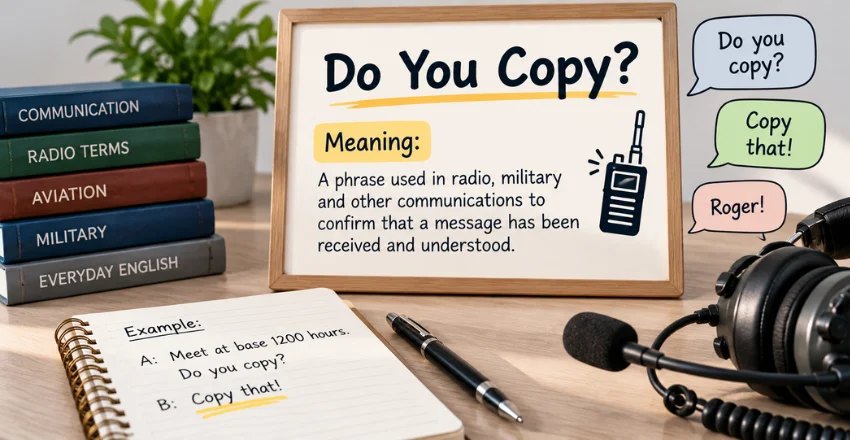
Yes, Americans sometimes use the expression even when no radio is involved. In a text message, “copy that” can work like “got it,” and the question can be a playful way to check that someone understood an instruction. Tone matters because the wording can sound stern when the relationship or situation does not call for command-style language.
This movement from specialized language into casual communication is common in English. Online platforms have also created their own vocabulary, abbreviations, and shorthand, as Newsloger’s explainer on what KMS means on Snapchat shows. Readers interested in modern communication and digital culture can also browse the site’s Tech section for related explainers.
For ordinary workplace communication, “Got it,” “Understood,” or “I received your message” may sound more natural. The radio phrase works well when teams already use short operational language or when the speaker wants a playful effect. Choosing wording that matches the setting helps prevent a simple acknowledgment from sounding like an order.
7 Examples That Show the Meaning Clearly
| Situation | Example | What it communicates |
|---|---|---|
| Walkie-talkie | “Meet at the north entrance. Do you copy?” | Did you receive and understand the location? |
| Security team | “Gate three is closed.” “Copy that.” | Message received |
| Friends | “Bring the pizza, not the salad.” “Copy.” | Got it. |
| Gaming | “Stay behind the wall until I call you.” “I copy.” | Plan understood |
| Workplace | “The client call starts at ten.” “Understood.” | Information received |
| Poor signal | “Your last message broke up. Please repeat.” | The message was not fully understood. |
| Playful conversation | “No spoilers until Friday, copy?” “Copy that.” | Humorous confirmation |
These examples show why context matters more than the literal word copy. The phrase can be serious during operational communication and lighthearted between friends. Its central purpose stays consistent because one person wants confirmation that a message got through.
The Bottom Line
The phrase asks for confirmation that a message was successfully received and understood. It began as radio-related terminology and later became familiar in American movies, gaming, workplaces, and ordinary conversation. Knowing the difference between “copy,” “roger,” “wilco,” and “over” also helps you use each expression more accurately.
If you encounter unfamiliar communication terms online, context is usually the fastest way to identify the intended meaning. Newsloger’s Education section offers more explanatory content, while its technology coverage can help with modern digital terminology. Save this guide for the next time a movie, game, coworker, or radio operator asks whether you got the message.
Frequently Asked Questions
What does “do you copy?” mean? It means military or police-style speech.
It asks whether the other person received and understood the transmission. The wording is associated with two-way radio communication, although exact procedures differ between organizations. A response normally confirms whether the information came through clearly.
Is “copy that” the same as “roger that”?
They overlap in casual American speech, and both commonly acknowledge a message. Formal radio terminology can distinguish them more carefully, with “roger” specifically indicating receipt of the last transmission. If you are using professional radio equipment, follow the vocabulary required for that system.
Does “copy that” mean I will follow the instruction?
Not necessarily. It primarily acknowledges that the information was received or understood, while context may suggest that action will follow. In standardized radio terminology, “wilco” explicitly adds the idea that the speaker will comply.
Is saying “do you copy?” rude?
The phrase is not inherently rude, but tone can make it sound demanding. Among friends, it may be playful, while in an ordinary office it can sound more forceful than “Does that make sense?” Consider the relationship and setting before using radio-style wording.
What is the everyday translation?
For readers searching for the meaning, the simplest translation is “Did you hear and understand me?” “Did you get that?” and “Are we clear?” can express similar ideas, although their tone differs. The radio wording is more strongly associated with concise operational communication