
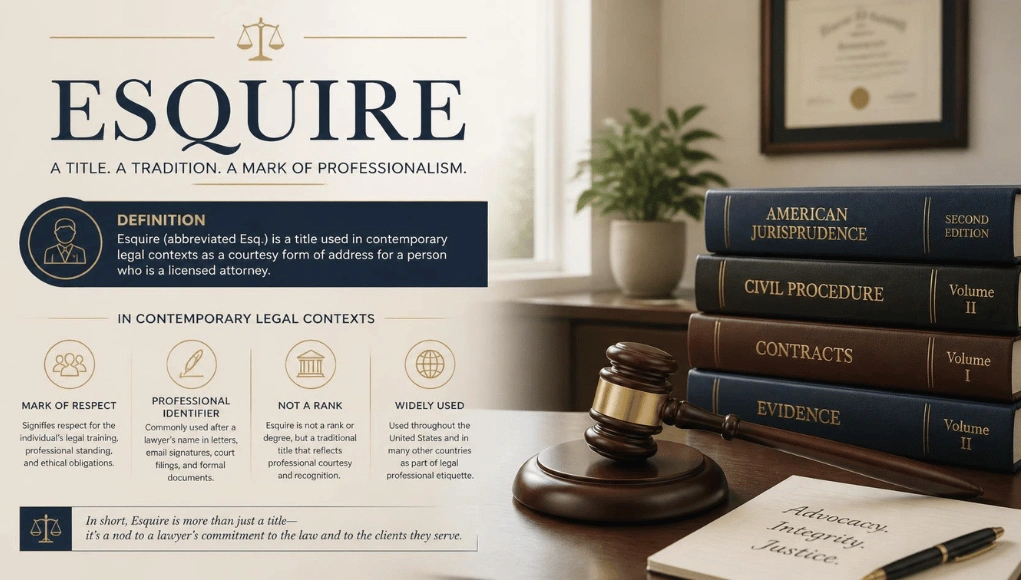
If you searched for the “esquire” meaning, you probably saw “Esq.” after a lawyer’s name and wondered whether it represents a degree, license, or professional rank. In modern U.S. legal usage, Esquire meaning is mainly a professional courtesy title associated with lawyers. It is not a separate academic degree or government-issued license.
Short answer: In the United States, “Esq.” is a courtesy title commonly placed after a lawyer’s full name, such as “Jordan Lee, Esq.” It signals an association with the legal profession, but the suffix itself is not a separate license, degree, or specialty credential. Current licensing status should be verified through the appropriate bar authority.
| Term | Plain meaning | What it tells you |
| Esq. | A professional courtesy suffix commonly associated with U.S. lawyers | It indicates a legal-profession convention, not a separate license. |
| J.D. | Juris Doctor law degree | The person earned a professional law degree. |
| Attorney | A legal professional authorized to represent clients | The person may practice law within an authorized jurisdiction. |
| Lawyer | A broad term for a legal professional | It is often used interchangeably with “attorney” in everyday U.S. usage. |
The important distinction is between education, professional authorization, and a courtesy title. Having a law degree and having the authority to practice law are not the same thing. Practicing attorneys must meet licensing requirements, while “Esq.” itself is not an official government-issued title.
Key Takeaways
- “Esq.” is commonly written after a lawyer’s name in the United States.
- It is a professional courtesy title rather than an additional academic degree.
- A J.D. shows legal education, but it does not by itself prove current bar status.
- The suffix does not reveal a lawyer’s specialty, experience, or disciplinary history.
- British and American uses of the term developed differently.
- If current licensing matters, verify the lawyer through the appropriate state bar.
Esquire Meaning in Modern U.S. Legal Use

In American legal usage, “Esq.” usually denotes a lawyer. The title is commonly appended to a lawyer’s name in formal written communication. Esquire is a title and should not be confused with a government-issued credential. U.S. law does not generally treat “Esquire” as an academic degree, professional license, or official government title. Instead, professional convention has associated it with members of the legal profession.
Esquire means that distinction matters when you are choosing legal help. The letters after a person’s name do not replace a bar-status check, nor do they tell you whether a lawyer handles your specific type of legal problem. For more explanations about the legal profession, court issues, and related topics, you can browse Newsloger’s Law section.
Where the Title Esquire Came From
The term has a much older history than its modern connection with attorneys. The word developed from older forms related to “squire.” Its deeper historical roots refer to a shield bearer. In medieval society, the title could describe a man below the rank of knight or someone preparing for knighthood.
That background helps explain the formal tone the word still carries. Over time, its social meaning changed, particularly as English-speaking countries developed different customs surrounding professional and social titles.
The modern American legal use is a later development. Someone who writes “Esq.” after a name today is not claiming a medieval social rank.
Esq. vs. J.D., Lawyer, and Attorney

These terms often appear in the same professional context, but they describe different things.
| Term | Category | Main purpose | Does it alone prove current authority to practice law? |
| Esq. | Courtesy title | Identifies a lawyer by professional convention | No |
| J.D. | Academic degree | Shows completion of a Juris Doctor program | No |
| Attorney | Professional role | Refers to someone authorized to provide legal representation | Not without confirming current jurisdiction and standing |
| Lawyer | General professional term | Refers broadly to a person in the legal profession | Current licensing should be verified when necessary. |
“A J.D.” is an educational qualification, while “Esq.” is a professional title used by convention. They are not interchangeable credentials. A law graduate can hold a J.D. without having current authority to practice law. Practicing attorneys must satisfy the licensing rules of the jurisdiction in which they work.
The distinction becomes especially useful when a problem involves more than one profession. For example, Newsloger’s guide to choosing a tax attorney vs. CPA explains why the right professional depends on the work you need, not simply on the letters appearing after a person’s name.
How to Use Esq. in a Name or Formal Correspondence
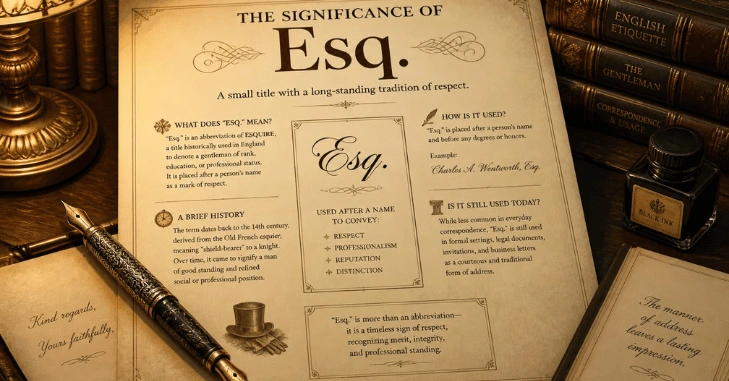
In U.S. written communication, the abbreviation normally follows the person’s full name.
For example:
- Jordan Lee, Esq.
- Maya Collins, Esq.
- Robert Chen, Esq.
Traditionally, “Esq.” is most often used when referring to another lawyer in writing. Professional naming practices vary, so you may also see attorneys use the suffix in signatures, biographies, business cards, or firm profiles.
You do not need to use the title every time you speak to an attorney. In ordinary conversation, using the person’s preferred name or professional form of address is usually sufficient. The simplest approach is to treat “Esq.” as a written professional courtesy rather than a rank that must be spoken aloud.
What Esq. Does Not Tell You About a Lawyer
Seeing the suffix can provide professional context, but it should not be treated as a complete background check.
It does not tell you:
- which areas of law the lawyer practices;
- how many years of experience the lawyer has;
- whether the lawyer has faced professional discipline;
- whether the lawyer is admitted to practice in the jurisdiction relevant to your case;
- whether the lawyer is a good fit for your specific legal problem.
This distinction follows from the nature of the title itself. Because the suffix is not a separate license, it cannot replace official records showing bar admission, professional standing, or disciplinary history.
If you are considering hiring legal counsel, check the appropriate state bar directory. You should also review the lawyer’s practice areas, relevant experience, and any publicly available disciplinary information.
Professional titles reveal only part of what lawyers do. Newsloger’s article about how law firms support disaster-relief victims provides another example of how legal work extends far beyond a professional title.
U.S. and U.K. Usage Are Different
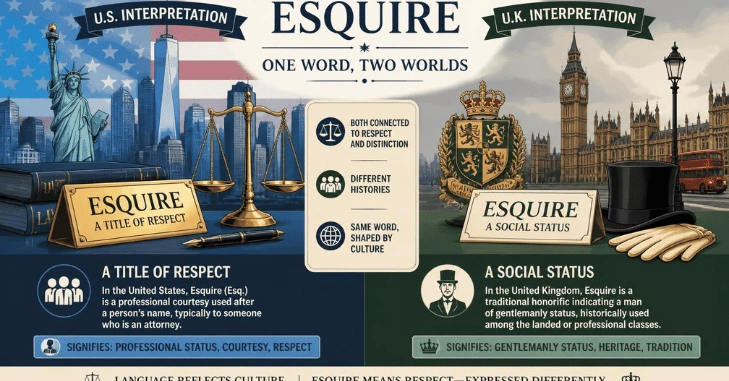
Context matters because the title developed differently in the United States and the United Kingdom. In modern U.S. usage, “Esq.” is mainly associated with lawyers and is placed after a person’s name. In traditional British usage, “Esquire” has also functioned as a formal courtesy title for men and historically carried social meanings unrelated to the legal profession.
The term also has an older historical meaning connected with men who served knights or held a particular social rank.
If you encounter “Esq.” on an American law firm website, the legal-profession meaning is usually the relevant one. In an older British letter or historical document, however, the term may have an entirely different meaning.
What to Remember
The easiest way to understand the title is to separate it from formal credentials. “Esq.” is a professional convention. A J.D. is an academic degree. Bar admission and good standing determine whether someone is currently authorized to practice law in a particular jurisdiction.
Esquire means if you see the suffix after a name, treat it as an indication that the person is being presented as a lawyer, not as proof of specialization, experience, or current licensing status.
For more plain-language explanations of legal terms and professional roles, continue exploring Newsloger’s Law articles.
Frequently Asked Questions
In modern U.S. usage, it usually means the person is being identified as a lawyer. The abbreviation “Esq.” appears after the name as a professional courtesy title. It is not a separate law degree or government-issued license.
No. “Attorney” describes a professional legal role, while “Esq.” is a courtesy suffix commonly associated with lawyers. The same person may be described both ways, but the terms serve different purposes.
Not necessarily. A J.D. shows that someone earned a law degree, but it does not by itself establish current bar admission or authority to practice law. “Esq.” is generally associated with lawyers as a matter of professional convention.
A person should not use “Esq.” to falsely imply legal qualifications or professional status. In the United States, the suffix is conventionally associated with lawyers, even though it is not a separate government-issued license.
Yes. In modern U.S. legal usage, women and men can both use “Esq.” after their names.
Usually not. The title is mainly used in written names and formal correspondence. In conversation, using the lawyer’s preferred name or normal professional form of address is generally clearer.