

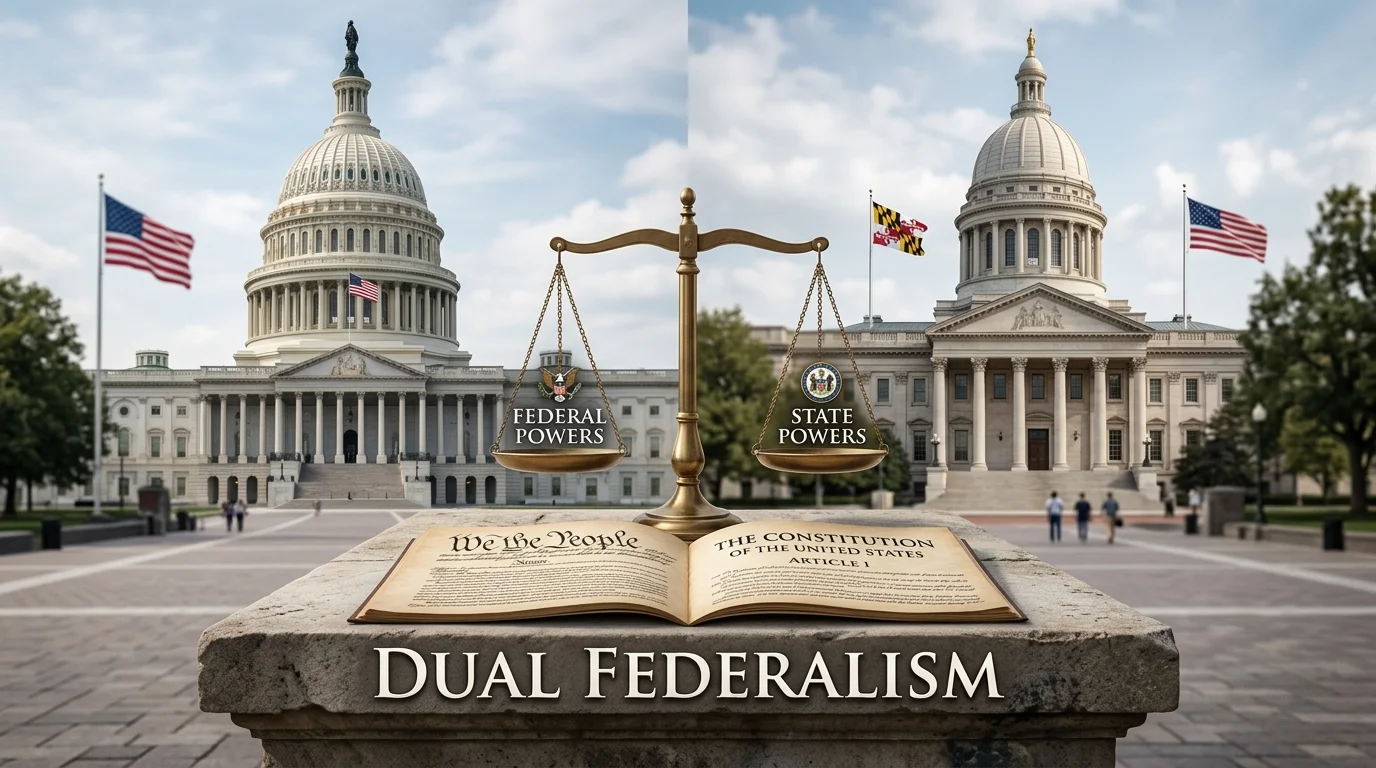
The United States has always divided political authority between the national government and the states, but that relationship has not remained constant. For much of American history, courts and political leaders treated the two levels of government as occupying distinct areas of authority, an approach commonly known as dual federalism. The model helped shape debates over commerce, taxation, education, public safety, and other areas of government responsibility. Understanding it also makes modern disputes over federal and state power much easier to follow.
This arrangement is often described as “layer-cake federalism” because each level of government is pictured as a separate layer with its own responsibilities. The national government exercises powers granted by the Constitution, while states retain substantial authority over matters traditionally handled within their borders. In practice, the separation was never perfectly clean, but the idea strongly influenced American constitutional law and political development.
Short answer: Dual federalism is a model in which the U.S. federal government and state governments operate in largely separate spheres of authority. The federal government exercises enumerated constitutional powers, while states retain broad reserved powers. Because the two levels are pictured as distinct layers, the model is often called the layer-cake model.
The Model at a Glance
| Feature | What it means |
|---|---|
| Basic idea | Federal and state governments have separate areas of authority |
| Common nickname | Layer-cake federalism |
| Federal authority | Based primarily on powers granted by the U.S. Constitution |
| State authority | Includes powers reserved to states or the people |
| Key constitutional provisions | Article I, Section 8; the Tenth Amendment; the Supremacy Clause |
| Historical importance | Especially influential in the nineteenth and early twentieth centuries |
| Major change | The New Deal era expanded federal authority and encouraged greater federal-state cooperation |
| Modern U.S. system | More cooperative and overlapping than the classical model |
What Is Dual Federalism?
It is a theory of federal government in which national and state governments are understood as independent authorities operating within their own constitutional spheres. Neither level is simply an administrative branch of the other, and both exercise power directly over people. The defining feature is therefore not the existence of two levels of government alone, but the attempt to maintain meaningful boundaries between their responsibilities.
Under this model, Congress is a government of enumerated powers, meaning it must generally connect federal action to authority granted by the Constitution. States, by contrast, possess broad governmental authority that does not depend on receiving a detailed list of powers from Congress. The Tenth Amendment reinforces this structure by reserving to the states or the people powers not delegated to the United States and not prohibited to the states.
This division does not mean the federal and state governments never possess similar powers. Both can tax, establish courts, borrow money, and perform other functions, creating what are known as concurrent powers. That overlap is one reason real American federalism has always been more complicated than the simple layer-cake illustration suggests.
Why Is It Called Layer-Cake Federalism?
The layer-cake comparison makes the theory easy to visualize because the layers remain recognizable rather than blending together. One layer represents federal authority, and another represents state authority, with each government carrying out its assigned responsibilities. Educational treatments often contrast this picture with cooperative federalism, represented as a marble cake because federal and state activities are mixed together.
The analogy is useful, but it should not be interpreted too literally. Federal and state governments interacted even during periods strongly associated with the doctrine, while constitutional disputes frequently arose because the boundary between interstate and local activity was difficult to define. The model is therefore best understood as a constitutional theory and historical tendency rather than proof that the two governments once operated in total isolation.
What Is the Constitutional Basis for the Model?
Several parts of the Constitution help explain why the United States developed a federal system with separate centers of authority. Article I, Section 8 grants Congress powers including taxation, borrowing, regulating interstate and foreign commerce, establishing certain national rules, and supporting the military. Because federal legislative power begins with constitutional grants of authority, those enumerated powers became central to disputes over how far Congress could reach.
The Tenth Amendment provides the other side of the structure by confirming that powers not delegated to the United States or prohibited to the states are reserved to the states or the people. It does not provide a simple catalog of state responsibilities, but it reinforces the principle that the federal government is constitutionally limited. Modern Supreme Court doctrine continues to treat federalism as imposing meaningful structural limits in certain circumstances.
The Supremacy Clause adds an important qualification because valid federal law is the supreme law of the land when federal and state law conflict. The doctrine therefore never meant that a state could disregard a constitutional federal law simply because it preferred its own policy. Instead, the historical doctrine attempted to reduce conflict by defining areas in which federal and state governments were each considered preeminent.
Federal Powers and State Powers Under the Model

Federal responsibilities are most clearly associated with subjects requiring national authority, such as national defense, foreign relations, currency, and regulation of interstate commerce. States traditionally exercise broad authority over areas such as local policing, property rules, family law, education, licensing, and public health, although federal constitutional and statutory rules can still affect many of these subjects. The exact boundary has changed repeatedly because Supreme Court decisions have expanded or limited how constitutional powers are interpreted.
Marriage offers a clear example of how significant state authority can remain within the federal system. States and localities administer marriage licenses and many procedural requirements under state and local law, even though federal constitutional rules and statutes can affect marriage-related rights and benefits. Newsloger readers can see that state-centered structure in the site’s guide to how to get married in the United States.
How the Doctrine Developed in U.S. History
The doctrine’s roots reach back to the Constitution’s creation, which established a national government with specified powers while preserving states as important political entities. Early constitutional disputes quickly demonstrated, however, that drawing the boundary would be difficult. In McCulloch v. Maryland (1819), for example, the Supreme Court interpreted federal power broadly enough to uphold Congress’s authority to establish a national bank and rejected Maryland’s attempt to tax it.
The doctrine became particularly important in the late nineteenth and early twentieth centuries, when the Supreme Court frequently treated state and federal regulatory authority as occupying largely separate zones. The Constitution Annotated describes this period as one in which the Court adopted a comparatively narrow understanding of Congress’s Commerce Clause authority. Courts therefore had to decide whether an economic activity was interstate commerce subject to federal regulation or a local matter beyond Congress’s reach.
Cases from this period sometimes prevented Congress from regulating matters the Court considered local. The approach reflected the belief that allowing federal authority to extend too far into manufacturing, labor, or other intrastate activity could erase the constitutional distinction between national and state powers. That reasoning gradually became harder to maintain as industrialization tied local production, employment, transportation, and markets more closely to the national economy.
Why Did the Model Decline?
The Great Depression created pressure for a national response to economic problems that crossed state boundaries. President Franklin D. Roosevelt’s New Deal dramatically expanded federal economic regulation and spending, while a series of Supreme Court decisions beginning in the late 1930s accepted a broader role for national authority. The older doctrine of largely separate regulatory spheres consequently lost much of its influence.
Key decisions, including NLRB v. Jones & Laughlin Steel Corp. (1937), United States v. Darby (1941), and Wickard v. Filburn (1942), reflected the Court’s broader interpretation of national economic power. Congress could regulate activities with sufficiently important connections to interstate commerce even when those activities occurred within one state. The result was a constitutional environment in which federal and state governments increasingly regulated overlapping subjects rather than remaining within rigidly separated domains.
This change produced what is usually called cooperative federalism. Federal programs increasingly relied on state agencies, grants, shared funding, and joint administration to pursue national policy goals. OpenStax describes the resulting model as one in which the boundaries between levels of government became less distinct, creating the familiar marble-cake comparison.
Dual Federalism vs. Cooperative Federalism
| Dual federalism | Cooperative federalism |
|---|---|
| Powers are treated as relatively separate | Responsibilities frequently overlap |
| “Layer-cake” model | “Marble-cake” model |
| Strong emphasis on distinct jurisdictions | Strong emphasis on coordination |
| Federal authority tied closely to enumerated powers | Federal programs often influence state policy through regulation and funding |
| Commonly associated with earlier U.S. history | Became especially important after the New Deal |
| States act with greater independence in their sphere | Federal and state agencies often administer policy together |
The difference is therefore mainly about how the two levels of government interact rather than whether states continue to possess constitutional status. Cooperative federalism did not abolish state governments or convert the United States into a unitary system. It changed the practical relationship by making shared programs, overlapping regulation, and intergovernmental funding much more common.
Examples of Separate Federal and State Authority
A straightforward example is national defense, which is primarily a federal responsibility because the Constitution grants the national government major military and foreign-affairs powers. A contrasting example is the routine administration of local schools, which has traditionally been handled primarily through state and local government. These examples show the basic idea even though federal spending, constitutional requirements, and national laws can now influence policy in areas historically associated with states.
Another example comes from the historical treatment of commerce. Under a strict dual approach, Congress could regulate commerce among the states while purely local economic activity remained under state authority. The central difficulty was determining when local activity affected interstate commerce strongly enough to justify federal regulation, a question that became increasingly important as the American economy became more interconnected.
State family and property law also illustrate the continuing importance of decentralized authority. Rules concerning property, contracts, marriage procedures, and similar matters commonly arise under state law, even when federal law creates additional rights or limits. Readers interested in legal terminology and state-law concepts can also explore Newsloger’s Law section for related explanations.
Is Dual Federalism Still Relevant Today?
The classical model does not accurately describe most modern American government because federal and state responsibilities now overlap extensively. Health care, transportation, environmental regulation, education, criminal justice, disaster response, and social programs routinely involve more than one level of government. Modern federalism therefore looks much more cooperative and interconnected than the idealized layer-cake system.
The underlying principle of state sovereignty has not disappeared, however. Supreme Court decisions beginning in the 1990s strengthened the anti-commandeering doctrine, under which Congress generally cannot order state legislatures or executive officials to administer a federal regulatory program. Decisions such as New York v. United States and Printz v. United States demonstrate that meaningful constitutional boundaries between federal and state institutions still exist.
These decisions should not be mistaken for a complete return to nineteenth-century separate spheres. Modern federal authority remains much broader than it was under the classical model, especially in areas connected with interstate commerce, spending, and constitutional rights. A continuing argument remains over where national power ends, where state autonomy begins, and how the Constitution protects both levels of government.
Advantages and Criticisms of the Model
Supporters of a clearer division of power argue that decentralization can make governments more accountable to the communities they serve. States can adopt different policies to meet local preferences, and citizens can more easily identify which level of government is responsible for a particular decision. Separating authority can also prevent excessive concentration of political power in one national institution.
Critics point out that rigid separation can make nationwide problems harder to address when economic activity, environmental effects, transportation networks, or civil rights concerns cross state borders. Strong state autonomy can also produce major differences in public services, protections, and regulatory standards from one state to another. American history demonstrates that disagreements about federal intervention have often involved not only administrative efficiency but fundamental questions about equality, economic regulation, and constitutional rights.
The broader debate reflects an old political question: how should power be distributed to produce both effective government and meaningful limits on authority? That question extends well beyond American federalism and appears throughout the history of political thought. Readers interested in those wider questions about justice and political organization may also find Newsloger’s discussion of Plato’s Republic and its relevance today useful.
Frequently Asked Questions
What is dual federalism in simple terms?
The term means that the federal government and state governments are expected to handle different areas of public policy rather than constantly sharing responsibility. Each level possesses authority of its own instead of receiving all power from the other. The layer-cake metaphor represents those separate areas of authority.
Why is it called layer-cake federalism?
It is called layer-cake federalism because the model pictures federal and state authority as clearly distinguishable layers. Each level of government has responsibilities that are supposed to remain largely within its own sphere. The metaphor contrasts with cooperative federalism’s marble-cake model, in which responsibilities are more thoroughly mixed.
What amendment is most closely associated with the model?
The Tenth Amendment is especially important because it reserves undelegated powers to the states or the people. Article I’s enumerated powers are equally important for identifying the authority Congress has. The model therefore depends on reading the Constitution’s grants and reservations of power together rather than relying on a single amendment.
When did dual federalism end?
There is no single date on which it formally ended because it was a constitutional approach rather than a statute that could simply be repealed. Its influence declined sharply during the New Deal era, especially as the Supreme Court accepted broader federal economic regulation beginning in the late 1930s. By the 1940s, cooperative and overlapping federal-state authority had become much more important.
Is the United States a dual federal system today?
The United States remains a federal country, but its modern system is not the classical model. Federal and state governments now cooperate and overlap across many major policy areas while retaining separate constitutional identities. Modern doctrines such as the anti-commandeering principle still protect certain aspects of state autonomy.
Conclusion
The doctrine provides one of the clearest ways to understand the changing relationship between the federal government and the states. Its layer-cake model emphasized separate spheres of authority, limited national powers, and meaningful state sovereignty, but economic change and the New Deal pushed American government toward a more cooperative system. The classical model may no longer describe everyday government, yet its central question, where federal power should stop and state authority should begin, remains part of U.S. constitutional debate.
Studying the concept also helps explain why modern disagreements over federal regulation cannot be reduced to a simple choice between national and state control. American federalism has always involved constitutional boundaries, practical overlap, judicial interpretation, and changing political needs. It is therefore important not only as a historical model, but as a foundation for understanding how American government developed into the system that exists today.